

Custom CBD packaging serves three masters at once: regulatory compliance (child-resistant requirements, label space, tamper evidence), product protection (light, moisture, and air barriers for oils, edibles, and flower), and brand differentiation in a crowded shelf and e-commerce environment. The right packaging choice depends on your product form (tincture, topical, edible, vape, flower), sales channel (dispensary, direct-to-consumer, wholesale), and the jurisdictions you ship to. This guide walks through the decisions in order so you can brief a packaging partner and request an accurate quote.
What makes CBD packaging different
CBD packaging is not just "boxes for CBD products." In most U.S. states and many international markets, packaging for hemp-derived and cannabis-adjacent products must meet specific requirements that do not apply to general wellness or cosmetic goods:
Child-resistant (CR) certification per CPSC 16 CFR 1700 for many product categories, especially edibles, tinctures, and vapes.
Tamper-evident features such as shrink bands, tear strips, or breakaway caps.
Label panel space for mandated warnings, cannabinoid content, batch/lot numbers, QR codes to COAs, and "keep out of reach of children" statements.
Opaque or UV-blocking materials for light-sensitive extracts and oils.
Food-safe or pharmaceutical-grade liners when the packaging contacts ingestibles directly.
If your packaging partner cannot speak to these requirements or does not offer pre-tested CR structures, you risk launch delays, compliance violations, or recalls.
When brands should choose custom CBD packaging over stock
Stock packaging works for early prototypes and very small test runs. Move to custom when:
You need specific child-resistant mechanisms matched to your product form (push-turn caps for bottles, CR slider boxes for edibles, CR mylar bags for flower).
Your label panel dimensions must fit state-mandated text without shrinking fonts below readability thresholds.
You want brand-owned structural IP — a unique box style, insert geometry, or unboxing sequence that competitors cannot buy off the shelf.
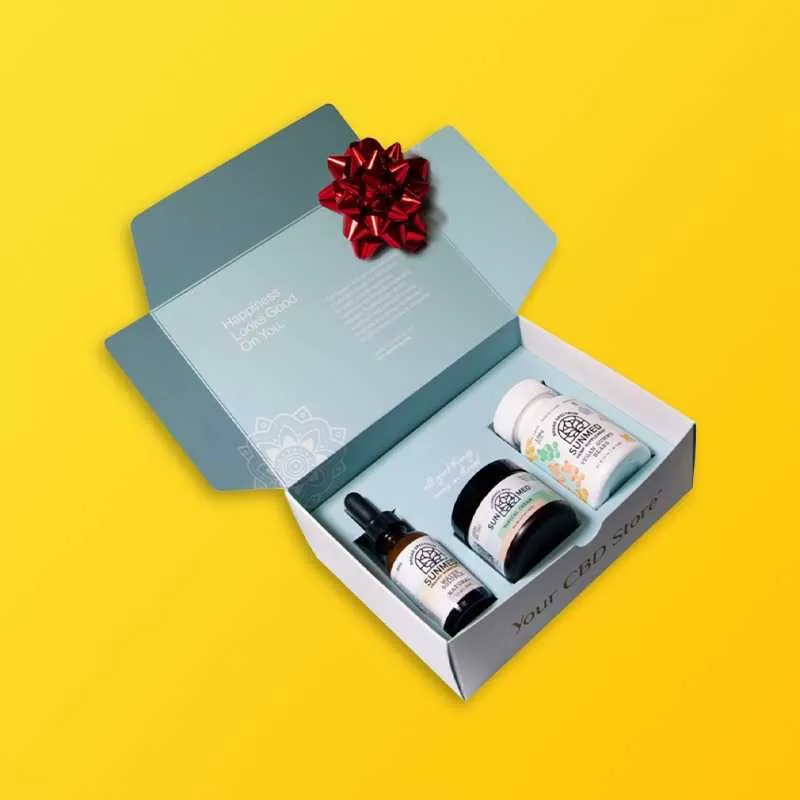
You ship multi-SKU kits (starter bundles, subscription boxes) that need a single outer structure with dedicated cavities.
Your MOQ has reached 500–1,000 units per SKU, where custom tooling amortizes below stock per-unit cost.
Structural styles for CBD products
The product form dictates the structure. Match the box to the primary package (bottle, jar, bag, cartridge) and the compliance requirement.
| Product form | Common primary package | Compliant outer structure | Notes | |--------------|------------------------|---------------------------|-------| | Tincture/oil (10–60 ml) | Glass dropper bottle | CR tuck box or auto-lock box with insert | Insert holds bottle upright; CR feature on box or cap | | Topical/balm (15–100 ml) | Jar or tin | CR sleeve box or two-piece rigid with CR jar lid | Sleeve slides over jar; tamper seal on lid | | Edible (gummies, chocolates) | Pouch or tray | CR slider/matchbox or auto-lock carton | Must pass CPSC 16 CFR 1700 for the assembled unit | | Vape cartridge (0.5–1 g) | CCELL or similar | CR tuck box with molded insert | Insert cradles cartridge; box provides label panel | | Flower/pre-roll (3.5–28 g) | Mylar bag or glass jar | CR mylar bag (standalone) or CR box for jar | Bag often is the CR device; box adds branding | | Multi-SKU kit | Mixed | Rigid setup box with custom foam/fabric platform | Premium unboxing; CR on individual inner units |
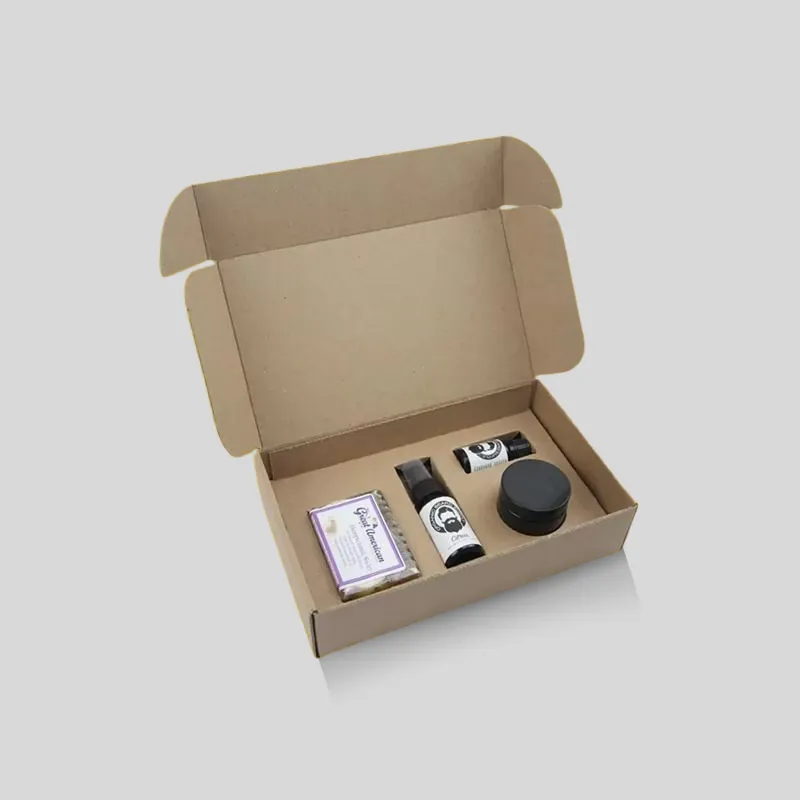
Inserts are not optional for liquids and glass. A precision-cut foam, EVA, or molded pulp insert prevents breakage, stops rattling in transit, and presents the product upright on opening. For tinctures, the insert also keeps the dropper vertical so oil does not leak into the cap threads.
Material and board choices
CBD packaging uses the same board grades as premium cosmetics and supplements, but with two extra filters: food-contact suitability for edibles/topicals and opacity/barrier performance for light-sensitive extracts.
SBS (Solid Bleached Sulfate) 18–24 pt — bright white, excellent print fidelity, standard for folding cartons. Use with matte or soft-touch lamination for a premium feel.
Uncoated kraft 18–24 pt — natural brown, eco-positioning, good for brands emphasizing sustainability. Lower print contrast; consider spot UV or foil for logo pop.
Corrugated E-flute or F-flute — for shipping-ready master cartons or heavier rigid boxes. Not a primary retail structure on its own.
Rigid chipboard 1.5–3 mm + wrapped paper — for premium gift sets, subscription boxes, and multi-SKU kits. Arrives assembled; highest perceived value.
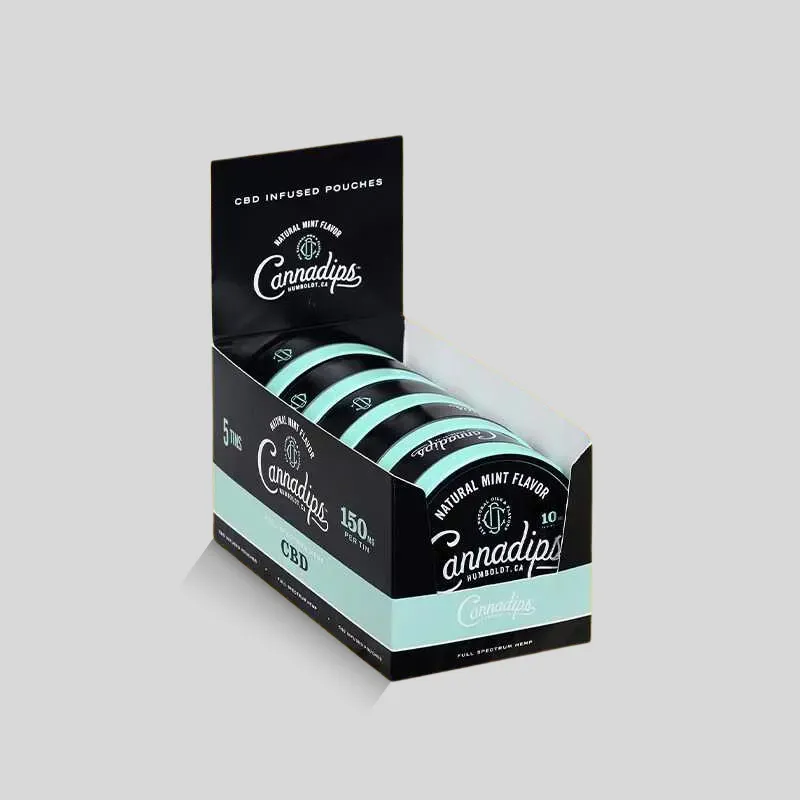
Mylar/foil laminate pouches — the primary CR device for flower and edibles. Can be custom-printed; often used inside a branded folding carton.
Lamination matters for compliance. Matte lamination resists fingerprints and writes well (for batch stickers). Gloss lamination offers higher color saturation but shows scratches. Soft-touch adds a tactile cue that supports premium positioning. For child-resistant boxes, the lamination must not interfere with the CR mechanism's engagement — confirm with your supplier's pre-production sample.
Printing, finish, and design choices
CBD brands operate in a high-competition visual environment. Printing and finish decisions should serve both compliance (legible mandated text) and conversion (shelf standout).
CMYK + 1–2 Pantone spots — most cost-effective for full-color art plus brand-color accuracy on logos.
Foil stamping (gold, silver, holographic) — elevates logo or key benefit callouts; works on SBS and rigid wrap.
Spot UV — highlights logo, pattern, or "lab tested" badge; pairs well with matte lamination for contrast.
Embossing/debossing — adds tactile dimension to logo or texture; avoid over mandated text areas.
Interior print — inside lid or tray print reinforces brand story during unboxing; no extra compliance risk.
Design for the label panel first. Before finalizing artwork, map every state-required text block (warning, cannabinoid profile, batch ID, COA QR, net weight, "manufactured by," "keep out of reach"). Leave 15–20 % clear space around mandated text for readability. Then build brand graphics around the fixed compliance zones.
Cost and MOQ factors (without guarantees)
Custom CBD packaging cost drivers, in descending order of impact:
Structure complexity — rigid > CR slider > auto-lock > straight tuck.
Child-resistant mechanism — CR-certified structures add tooling and per-unit cost vs. non-CR equivalents.
Board grade and caliper — 24 pt SBS > 18 pt SBS; rigid chipboard + wrap > folding carton.
Finish stack — matte lam + spot UV + foil > matte lam only > uncoated.
Insert type — custom die-cut foam > EVA > molded pulp > corrugated pad > none.
Run size — unit cost drops sharply at 1,000; 2,500; 5,000; 10,000 breaks.
Number of SKUs sharing a structure — one die line across 3–5 SKUs amortizes tooling.
Typical MOQs: 500–1,000 for folding cartons with existing die lines; 1,000–2,500 for new die lines; 250–500 for rigid boxes (higher per-unit, lower tooling). Mylar bags often start at 5,000–10,000 due to print cylinder minimums. Always request a digital proof and a physical pre-production sample before full run — especially for CR mechanisms.
Common mistakes to avoid
Assuming the cap makes the package child-resistant. CPSC tests the assembled unit (box + cap + insert). A CR cap in a non-CR box may fail.
Shrinking mandated text to fit a small panel. Most states specify minimum font size (often 6 pt or 1/16 inch). Non-compliant labels trigger stop-sale orders.
Choosing clear windows for light-sensitive oils. UV exposure degrades cannabinoids. Use opaque board or UV-blocking window film if a window is required.
Ordering packaging before finalizing bottle/jar dimensions. A 2 mm variance breaks the insert fit. Lock primary package specs first.
Skipping the pre-production sample for CR structures. Tooling adjustments after full run are expensive and delay launch by weeks.
Using non-food-safe ink or liner for edibles. Confirm FDA 21 CFR compliance for direct food contact materials.
Designing single-SKU structures for a 10-SKU line. One master die line with variable print plates saves thousands in tooling.
Quote checklist: prepare this before you inquire
Have the following ready to get an accurate, comparable quote in one round:
| Item | Detail needed | |------|---------------| | Product form(s) | Tincture, topical, edible, vape, flower, multi-SKU kit | | Primary package | Bottle/jar/bag dimensions (H × W × D), weight, material | | Target structure | Tuck, auto-lock, slider, rigid, sleeve, mailer, mylar bag | | Child-resistant requirement | Yes/No; if yes, which component (box, cap, bag) must be CR | | Tamper-evident requirement | Shrink band, tear strip, breakaway cap, induction seal | | Board preference | SBS, kraft, rigid chipboard, corrugated, mylar laminate | | Print spec | CMYK only, CMYK + PMS (how many), foil, spot UV, emboss | | Lamination | Matte, gloss, soft-touch, none | | Insert type | Foam (density), EVA, molded pulp, corrugated, none | | Quantity per SKU | Current run + 12-month forecast | | Number of SKUs | Shared die line or unique per SKU | | Shipping destination | Domestic zones, international (affects corrugate spec) | | Timeline | Need-by date; rush options (5–7 days) vs. standard (8–12 days) | | Compliance states | List of states/jurisdictions for label panel planning | | Sample requirement | Digital proof only, or physical pre-production sample |
Brisk Packaging includes free design support, unlimited artwork revisions, and a digital proof before production on every order. If you have dielines or existing artwork, share them. If you need design from concept, the in-house team can build to your brand guidelines and compliance map.
FAQ
Does Brisk Packaging provide child-resistant certified structures? Yes. Brisk offers CR-certified slider boxes, auto-lock cartons, tuck boxes with CR features, and CR mylar bags. The certification applies to the specific structure + closure combination; request the test report for your configuration.
Can I use one box structure across multiple CBD SKUs? Yes, if the primary packages share the same footprint (e.g., 30 ml dropper bottles across 5 SKUs). One die line, variable print plates. This is the most cost-efficient approach for line extensions.
What is the typical turnaround for custom CBD packaging? Standard production is 8–10 business days from artwork approval. Rush (5–7 days) is available for a surcharge. Pre-production sample adds 2–3 days but is strongly recommended for CR structures.
Are there setup or die-plate charges? No. Brisk Packaging charges no die-plate fees, no setup fees, and no artwork fees. The quoted price is the price you pay.
Can I get a physical sample before committing to a full run? Yes. Every order includes a free digital proof. A physical pre-production sample is available and recommended for child-resistant structures, rigid boxes, and new die lines.
What if I need packaging that complies with multiple state regulations? Design the label panel for the strictest state in your distribution footprint (largest mandated text, most required elements). Brisk's design team can map your compliance matrix and build a master artwork template.
Do you offer sustainable or recycled material options for CBD packaging? Yes. FSC-certified SBS, recycled kraft, and post-consumer content boards are available. For mylar bags, recyclable mono-material structures are an option where barrier requirements allow.
How do I ensure my packaging protects light-sensitive tinctures? Use opaque board (no window), or specify UV-blocking window film. For maximum protection, pair an opaque folding carton with an amber glass bottle and a CR cap.
Can Brisk help with dieline creation if I only have product dimensions? Yes. Provide primary package dimensions (H × W × D), desired structure type, and insert requirements. The design team will generate a production-ready dieline with bleed, glue flaps, and CR mechanism geometry.
---
Ready to spec your custom CBD packaging? Talk to a packaging specialist at Brisk Packaging for a no-obligation quote, free design support, and a physical pre-production sample before you commit. No die-plate charges. No hidden fees. Fast turnaround and worldwide shipping.