
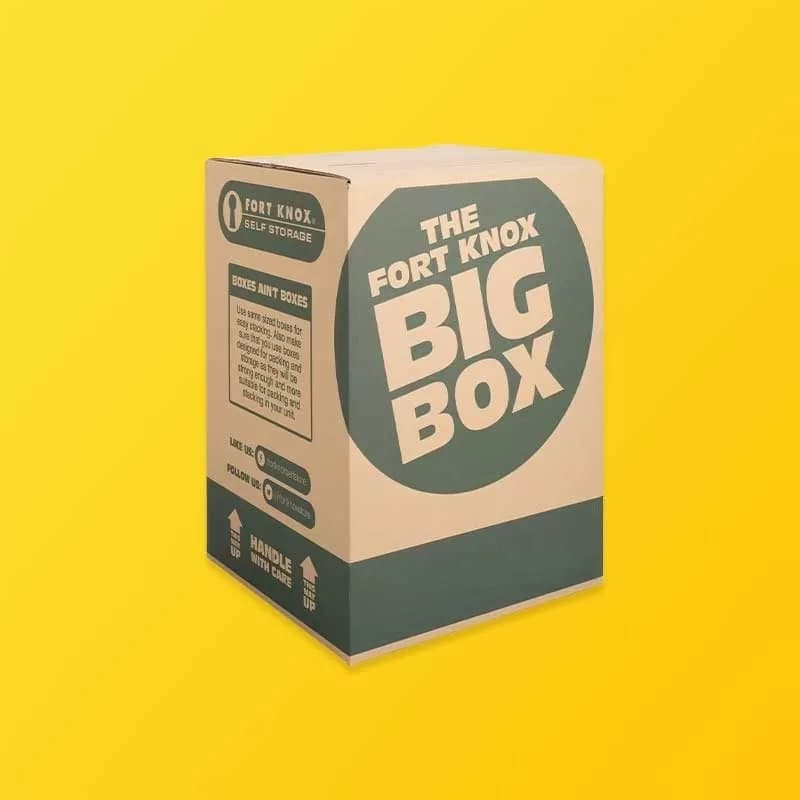
To choose custom storage boxes, evaluate four core technical factors: intended storage environment, required vertical stacking compression strength, structural opening frequency, and archival material chemistry. Unlike single-use shipping cartons that only need to survive a single freight transit cycle, storage containers must endure long-term static loads, repeated physical handling, fluctuating warehouse humidity, and potential chemical degradation over months or years.
Selecting the optimal custom storage box requires balancing heavy-duty board fluting (such as 32 ECT to 51 ECT double-wall corrugated), ergonomic reinforcements (like rolled die-cut handholes), lid mechanisms (lift-off telescope lids versus integrated flip tops), and specialized board treatments (such as acid-free alkaline buffering for documents or moisture-resistant barrier coatings for damp facilities).
Explore Brisk Packaging's Storage Boxes category to inspect structural styles, or use this comprehensive engineering guide to calculate stacking limits, select board grades, specify partition inserts, and prepare an accurate production request.
---
1. Define the Storage Profile and Environmental Demands
Every storage box specification begins with defining what is inside, how heavy it is, how high it will be stacked, and where it will live. Different use cases impose drastically different mechanical and chemical stresses on paper-based packaging:
`` +-----------------------------------------------------------------------------------+ | STORAGE PROFILES & DEMANDS | +----------------------+--------------------+-------------------+-------------------+ | Profile | Primary Stresses | Key Requirement | Recommended Style | +----------------------+--------------------+-------------------+-------------------+ | Office & Legal Files | Repeated access, | Lift-off lid, | Banker Box with | | (A4, Letter, Legal) | bottom sagging | rolled handles | double-wall base | +----------------------+--------------------+-------------------+-------------------+ | Archival & Records | Acid degradation, | pH 7.5-9.5, | Acid-Free Rigid | | (Museum, Medical) | light & oxidation | alkaline buffer | or Corrugated Box | +----------------------+--------------------+-------------------+-------------------+ | Warehouse & Parts | Static load, drop, | High ECT fluting, | Double-Wall Bin | | (Kits, Hardware) | internal shifting | partition grids | with Inserts | +----------------------+--------------------+-------------------+-------------------+ | Retail & Household | Aesthetic luxury, | Magnetic closure, | Foldable Rigid | | (Closet, Apparel) | space efficiency | collapsible flat | Setup Box | +----------------------+--------------------+-------------------+-------------------+ ``
Critical Operational Questions Before Specifying
- Static Duration: Will the box store contents for 30 days of temporary staging, 2–5 years of commercial record retention, or 50+ years of archival preservation?
- Access Frequency: Will staff open and close the container daily for inventory picking, monthly for audit reviews, or rarely once sealed?
- Humidity & Temperature: Will boxes be kept in a climate-controlled office (45–55% RH) or an unconditioned warehouse/basement where relative humidity routinely exceeds 75%?
- Stacking Configuration: Will boxes rest individually on pallet racking and steel shelving, or stack directly on top of each other 4 to 6 units high?
---
2. Structural Box Styles and Lid Mechanisms
The structural architecture of a storage box dictates its ease of assembly, handling ergonomics, and load-bearing performance.
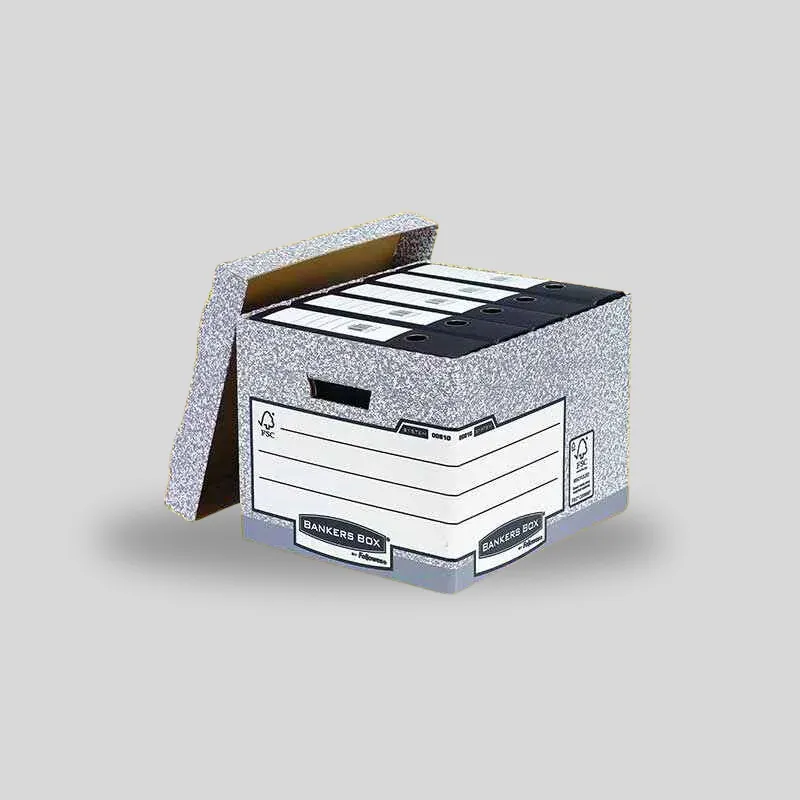
A. Classic Banker Boxes with Lift-Off Lids
Custom Banker Storage Boxes are the industry standard for document archiving, tax filings, legal briefs, and accounting records.
- Structure: Constructed from a single die-cut corrugated blank that folds without tape. Folding the side panels creates a double-wall end and a triple-wall bottom, providing superior resistance against base blowouts when lifted.
- Lid Mechanism: Separate shallow lift-off lid (telescoping cap) allows instant file access without unsealing tape or tearing tuck tabs.
- Best For: A4, letter-size, and legal-size document folders, binder storage, and general office reorganization.
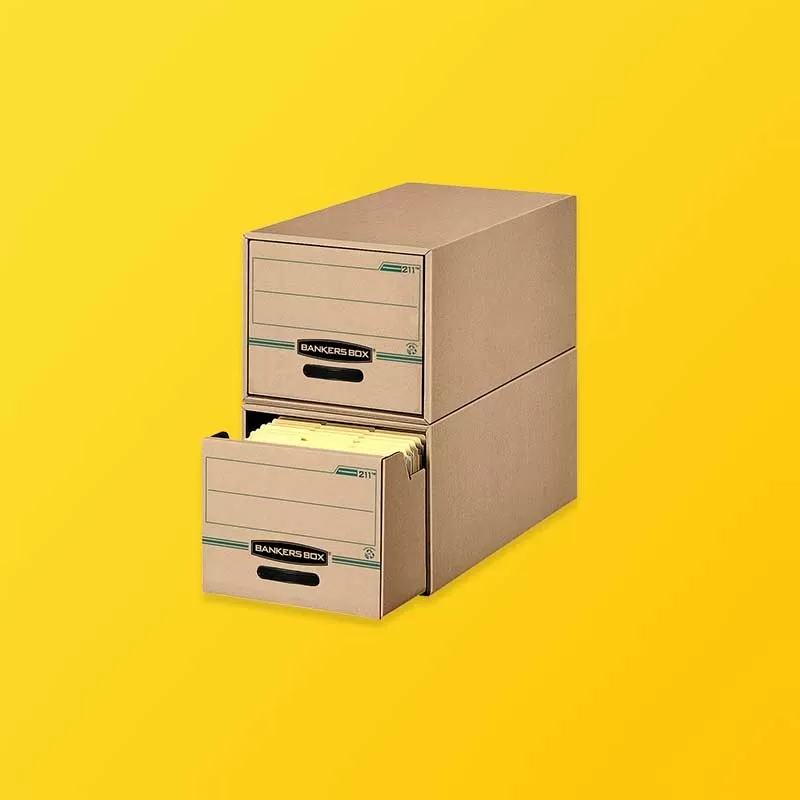
For high-capacity filing facilities, Custom Large Banker Boxes accommodate heavy ledger books, legal-size binders, and medical record folders while maintaining structural rigidity across the wider span.
B. Two-Piece Telescoping Storage Boxes
Custom Design Two Piece Storage Boxes feature a full-depth or partial-depth lid that slides completely over the base tray.
- Stacking Advantage: When the lid covers the base, the vertical sidewalls effectively become double-thickness along the entire perimeter. This dramatically increases compression resistance and prevents sidewall buckling under heavy vertical stacks.
- Dust & Light Seal: The overlapping telescoping perimeter prevents dust ingress and blocks ambient light exposure better than loose tuck-tab boxes.
- Best For: Industrial components, hardware kits, bulk printed collateral, and flat garment storage.
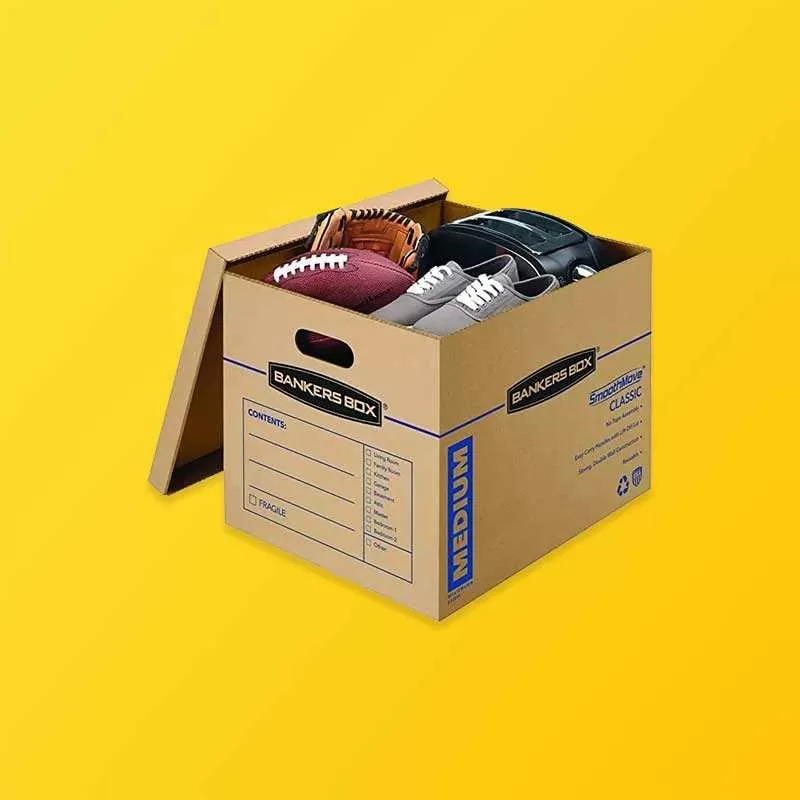
C. Tab-Locking File Storage Cartons
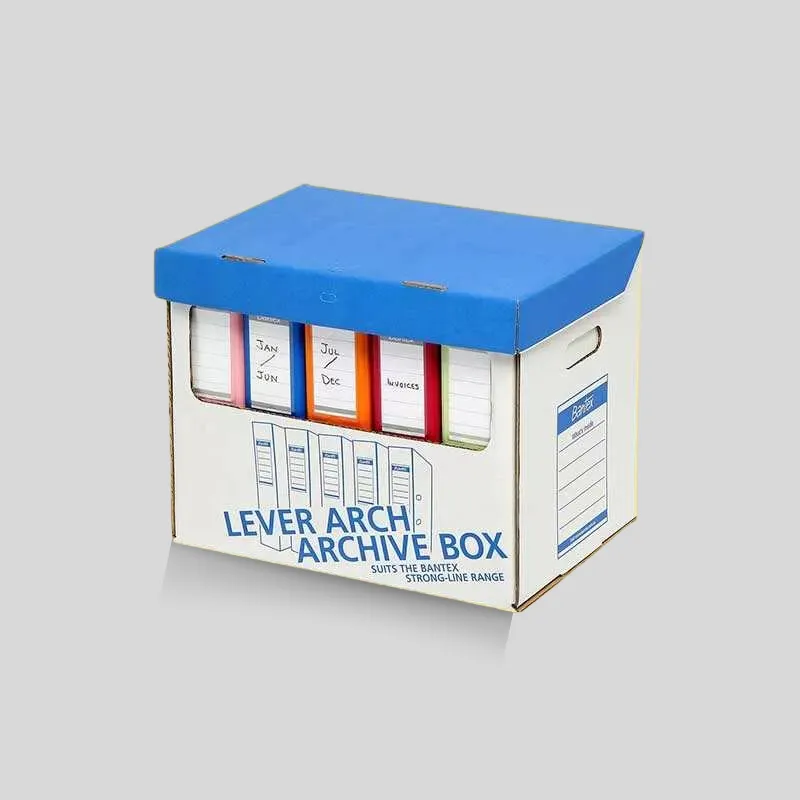
Custom Design Files Storage Boxes and Custom Design A4 Paper Storage Boxes utilize an integrated hinged top lid with front locking tabs.
- Security & Integrity: The attached lid cannot be misplaced during transit or file handling. Locking tabs prevent accidental spills if the box tilts.
- Stacking Profile: Flat top surface ensures uniform contact when stacked on steel archive shelving.
- Best For: Active record retrieval, client case files, reams of copy paper, and desktop document organizing.
D. Collapsible Foldable Storage Bins
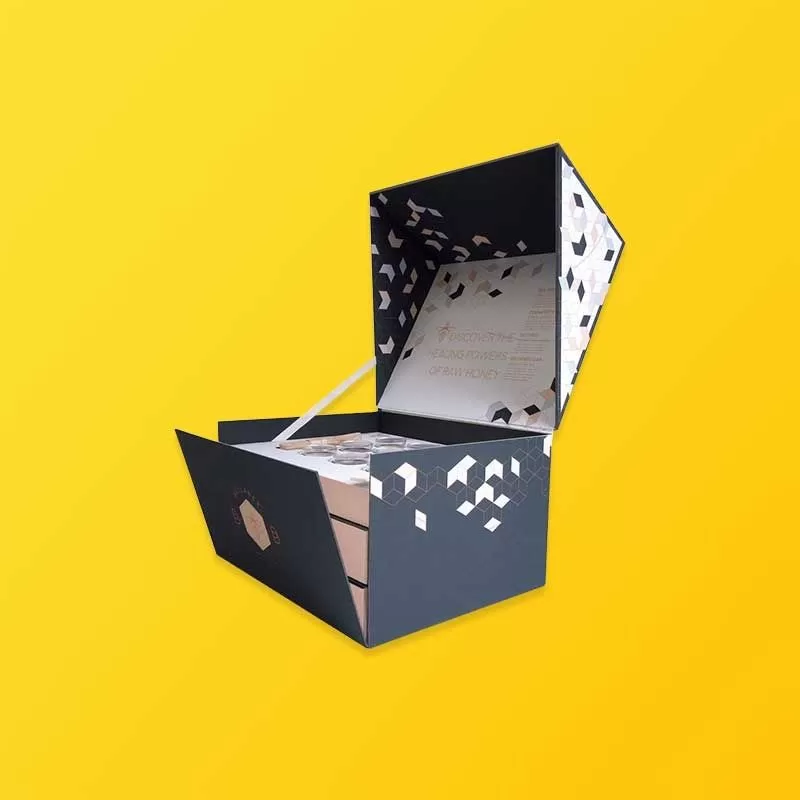
Custom Foldable Storage Boxes combine the premium aesthetic of rigid luxury boxes with flat-pack shipping logistics.
- Structure: Made from high-density greyboard wrapped in art paper, kraft liner, or coated buckram, scored at diagonal folding points with embedded magnetic flap closures.
- Space Savings: Ships 100% flat to minimize inbound freight costs and warehouse storage volume. Assembles in seconds by pulling the sidewalls upward and pressing the adhesive corner tabs or magnetic locks into place.
- Best For: Luxury closet organizers, seasonal apparel storage, branded retail storage products, and subscription kit archives.
E. Premium Rigid Setup Storage Boxes
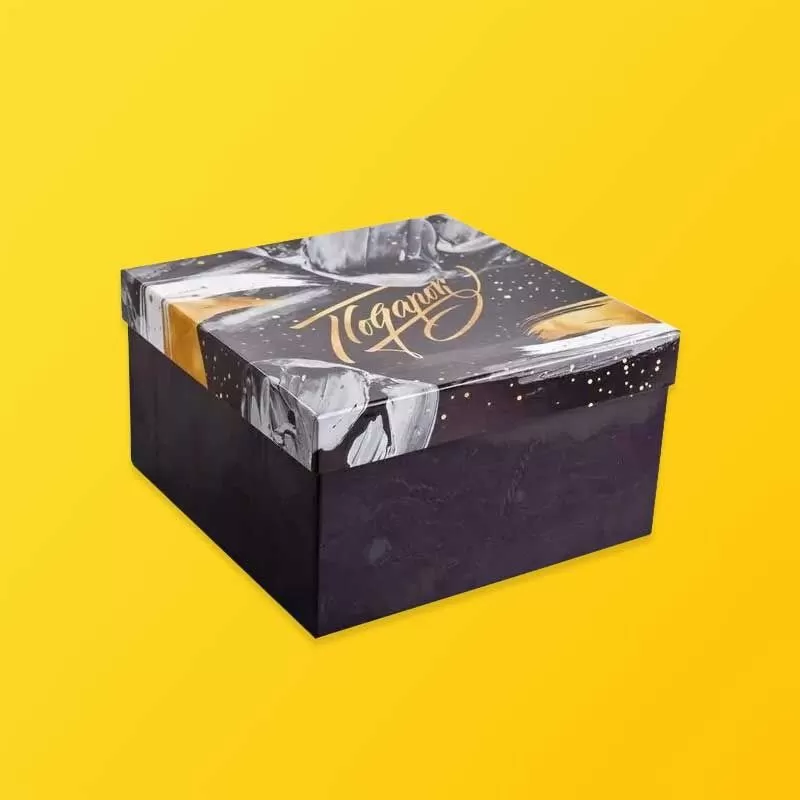
Custom Design Rigid Storage Boxes are non-collapsible setup boxes constructed from heavy 60 pt to 120 pt solid chipboard wrapped with premium textured paper, foil-stamped liners, or soft-touch laminate.
- Characteristics: Unmatched durability, zero assembly required, and seamless corner presentation.
- Best For: High-end corporate keepsake archives, luxury product presentation kits, heirloom storage, and executive desk organizers.
---
3. Corrugated Board Engineering: ECT vs. Mullen Burst Strength
When specifying corrugated cardboard for storage boxes, packaging buyers often encounter two distinct testing metrics: Edge Crush Test (ECT) and Mullen Burst Test (lbs/sq. in.). Understanding the distinction is vital for choosing the right storage grade:
`` +----------------------------------------------------------------------------------------+ | CORRUGATED BOARD SPECIFICATION MATRIX | +------------------+---------------+----------------+----------------+-------------------+ | Board Grade | Flute Type | ECT Rating | Mullen Rating | Max Recommended | | & Construction | | (lbs/in width) | (Burst Lbs) | Box Gross Weight | +------------------+---------------+----------------+----------------+-------------------+ | Standard Single | B-Flute | 32 ECT | 200# | 30 lbs (13.6 kg) | | Wall Corrugated | (1/8" / 3mm) | | | | +------------------+---------------+----------------+----------------+-------------------+ | Medium-Duty | C-Flute | 40-44 ECT | 250# | 45 lbs (20.4 kg) | | Single Wall | (11/64" / 4mm)| | | | +------------------+---------------+----------------+----------------+-------------------+ | Heavy-Duty | C-Flute or | 44-48 ECT | 275# | 65 lbs (29.5 kg) | | Single Wall | Double-Wall B | | | | +------------------+---------------+----------------+----------------+-------------------+ | Extra Heavy-Duty | BC Double Wall| 48-51 ECT | 350# | 90 lbs (40.8 kg) | | Double Wall | (1/4" / 6.4mm)| | | | +------------------+---------------+----------------+----------------+-------------------+ | Industrial Super | BC or EB | 51-60+ ECT | 400#+ | 120 lbs (54.4 kg) | | Double Wall | Double Wall | | | | +------------------+---------------+----------------+----------------+-------------------+ ``
Stacking vs. Puncture Resistance
- Edge Crush Test (ECT): Measures the top-to-bottom compressive strength of the corrugated fluting along its vertical edge. ECT is the primary metric for determining stacking performance in storage and warehouse palletization.
- Mullen Burst Test: Measures the hydraulic pressure required to rupture or puncture the face liners. Mullen is critical when storing sharp, heavy, or loose items (like metal fittings, bolts, or loose tools) that push outward against carton walls during handling.
Flute Profiles for Storage Applications
- B-Flute (approx. 1/8" thick): Higher flute frequency provides a smoother printing surface and excellent crush resistance. Ideal for die-cut self-locking file boxes and folding mailer bins.
- C-Flute (approx. 11/64" thick): Taller flutes provide greater vertical column strength and cushioning. The standard choice for single-wall shipping and archive boxes.
- BC-Flute Double Wall (approx. 1/4" thick): Combines B-flute on the exterior for puncture resistance and print fidelity with C-flute on the interior for maximum vertical stacking strength. Essential for heavy warehouse storage boxes exceeding 50 lbs.
---
4. Calculating Stacking Strength and Box Compression Test (BCT)
A common packaging failure in long-term storage is sidewall creep—where a bottom carton gradually buckles weeks after being stacked, causing the entire stack to tip. To prevent this, calculate the required Box Compression Test (BCT) strength using McKee's formula combined with realistic environmental safety factors.
`` BCT = Total Top Load × Environmental Safety Factor ``
Understanding Safety Factor Multipliers
The static compressive strength of corrugated paperboard degrades significantly under real-world warehouse conditions:
`` +-----------------------------------------------------------------------------------+ | ENVIRONMENTAL STRENGTH DEGRADATION FACTORS | +------------------------------------+-----------------------+----------------------+ | Environmental / Operational Stresses| Strength Loss (%) | Safety Factor Impact | +------------------------------------+-----------------------+----------------------+ | High Humidity (75% to 85% RH) | 40% – 55% loss | Multiplier: 1.8 – 2.2| +------------------------------------+-----------------------+----------------------+ | Long-Term Static Storage (>90 Days)| 45% – 50% loss | Multiplier: 1.8 – 2.0| +------------------------------------+-----------------------+----------------------+ | Interlocking Pallet Stacking | 40% – 50% loss | Multiplier: 1.7 – 2.0| +------------------------------------+-----------------------+----------------------+ | Misaligned / Overhanging Stacks | 20% – 30% loss | Multiplier: 1.3 – 1.5| +------------------------------------+-----------------------+----------------------+ ``
Practical Calculation Example: Warehouse Pallet Stacking
Suppose each filled storage box weighs 40 lbs, and boxes are stacked 5 units high on a pallet (meaning the bottom box supports 4 boxes above it):
- Direct Top Weight on Bottom Box: 4 boxes × 40 lbs = 160 lbs.
- Standard Climate-Controlled Office Safety Factor: 3.0× safety factor -> Required BCT = 480 lbs.
- Unconditioned Warehouse with Summer Humidity (80% RH) & Long-Term Storage: 5.0× safety factor -> Required BCT = 800 lbs.
Engineering Rule: For floor or pallet stacking in non-climate-controlled storage, always specify a minimum safety factor between 4.5× and 5.5× of the bottom box's static weight load.
---
5. Archival Preservation: Acid-Free and Lignin-Free Chemistry
Standard commercial kraft corrugated board contains residual lignin and acidic compounds from the wood pulping process. Over time (typically 2 to 7 years), these acids off-gas, causing enclosed paper documents, historical records, photographs, and textiles to turn yellow, brittle, and chemically degraded.
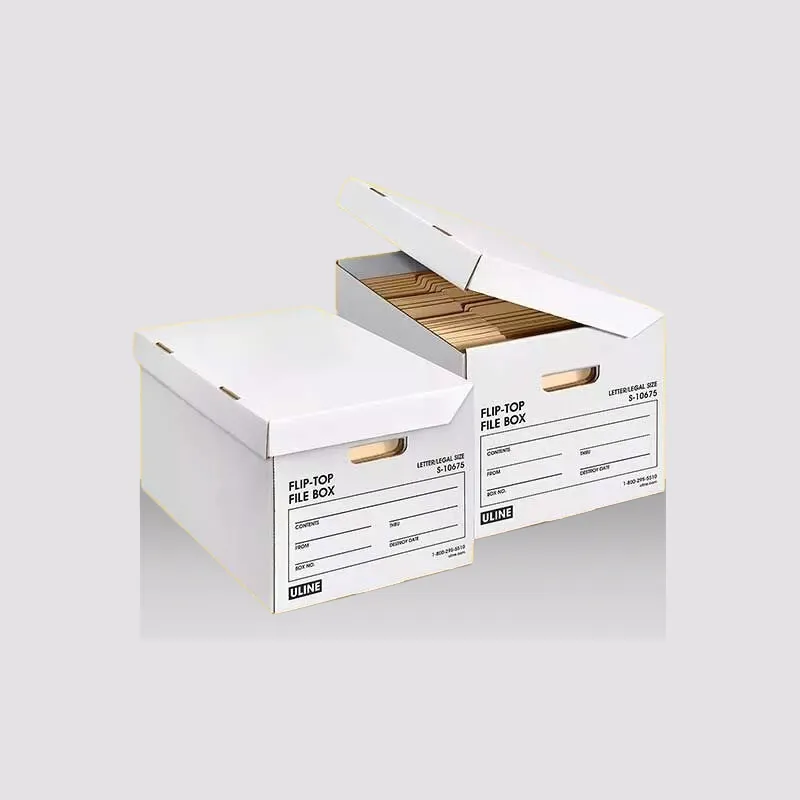
For museum archives, government record depositories, legal libraries, and medical record facilities, specify Custom Archival Storage Boxes meeting strict chemical standards:
Key Archival Specifications (ISO 16245 & ANSI/NISO Z39.48)
- Acid-Free pH Level: Board stock must have a neutral or slightly alkaline pH between 7.5 and 9.5.
- Alkaline Reserve (Buffering): Incorporates a 2% to 3% calcium carbonate (CaCO3) alkaline reserve buffer throughout the paper pulp. This neutralizes acidic contaminants entering the box from ambient air pollution or adjacent stored papers.
- Lignin-Free: Lignin content must measure under 1% (Kappa number < 5) to prevent light-induced oxidation and paper yellowing.
- Sulfur-Free & Reducible Sulfur Content: Must be below 0.0008% to prevent tarnishing when storing silver, photographic negatives, historical coins, or metallic artifacts.
- Photographic Activity Test (PAT / ISO 18916): Verifies that the paperboard, adhesives, and printing inks will not chemically react with photographic emulsions or cause binder fading over extended storage periods.
---
6. Compartmentalization, Inserts, and Partitions
When storing multi-item inventory, delicate glassware, bottled products, or loose electronic components, open box cavities allow contents to collide, scuff, and crush one another during movement.
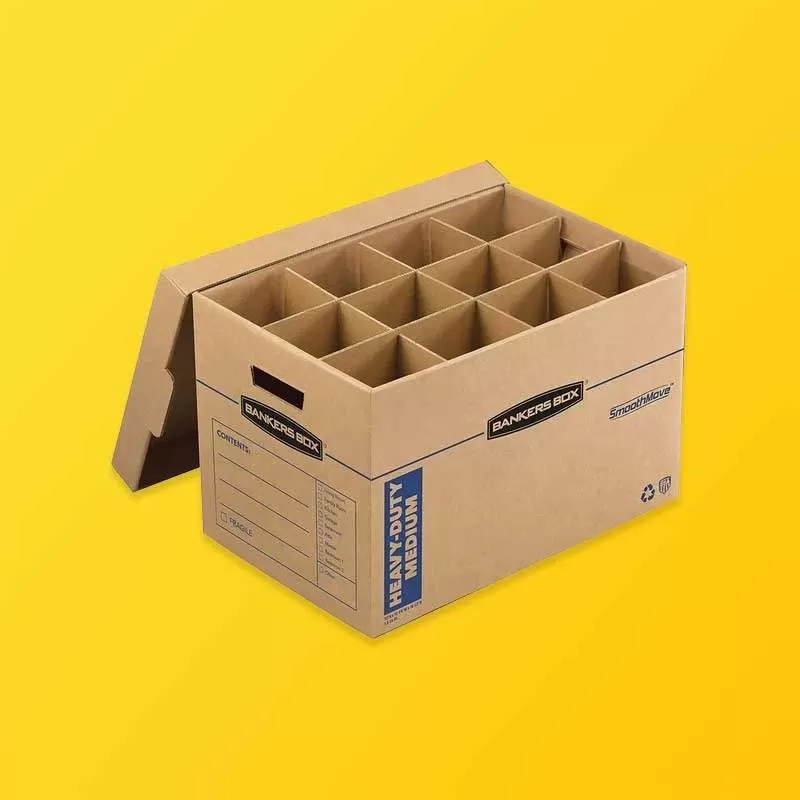
Custom Storage Boxes With Inserts solve internal shifting through precision-engineered internal partitions:
Internal Partition & Insert Options
- Interlocking Corrugated Grid Partitions: Interlocking slotted corrugated dividers create individual cells (e.g., 4-cell, 6-cell, 12-cell, or 24-cell matrices). The interlocking vertical walls dramatically boost overall box top-to-bottom compression strength while preventing bottle-to-bottle contact.
- Solid Chipboard / Paperboard Partitions: Thinner profile than corrugated fluting, maximizing the usable cell volume for small vials, electronic parts, sample bottles, and cosmetics.
- Molded Pulp Trays: Biodegradable, custom-contoured trays that cradle specific hardware parts, tools, or delicate components securely inside the outer storage carton.
- Closed-Cell Polyethylene (EPE) & EVA Foam Inserts: High-resilience, non-dusting foam routed or die-cut to hold sensitive electronics, optical instruments, and precision tooling.
---
7. Ergonomics, Handling, and Merchandising Features
A storage box must not only hold weight; human operators must be able to lift, retrieve, and identify it safely.
Ergonomic Lifting and Handle Engineering
- Rolled Die-Cut Handholes: Standard punched holes have raw, sharp corrugated edges that dig into fingers when lifting boxes over 20 lbs. Rolled handholes incorporate a fold-in flap that creates a smooth, double-thickness top edge for comfortable lifting.
- Plastic Handle Clip Inserts: Snap-in molded plastic handles distribute heavy loads across a wider surface area and prevent tearing on high-cycle storage containers.
- OSHA Manual Handling Considerations: Design storage box dimensions so that the maximum loaded weight does not exceed safe manual lifting thresholds (typically 35 to 50 lbs for a single operator).
Labeling, Identification, and Indexing Panels
- Dedicated Preprinted Indexing Zones: Prominent write-on blocks for box number, department, retention date, destroy-by date, and contents summary.
- Barcode & QR Code Windows: Clear scanning zones placed consistently on both short and long side panels to allow optical scanning without pulling boxes off pallet racks.
- Clear Vinyl / Poly Label Pockets: Heat-sealed or self-adhesive clear pockets that hold swappable index cards for reusable warehouse bins.
---
8. Common Storage Box Procurement Mistakes
Avoiding structural and logistical errors saves thousands of dollars in crushed inventory and replacement packaging:
`` +-------------------------------------------------------------------------------------+ | STORAGE BOX MISTAKES & PREVENTATIVE ACTIONS | +------------------------------+-------------------------+----------------------------+ | Common Procurement Mistake | Structural Consequence | Engineering Solution | +------------------------------+-------------------------+----------------------------+ | Using Standard 32 ECT Single | Lower sidewall buckles | Upgrade to 44/48 ECT single| | Wall for 5-High Pallets | after 4 weeks of static | wall or 48/51 ECT double | | | warehouse compression | wall for long-term stacks | +------------------------------+-------------------------+----------------------------+ | Ignoring Warehouse Humidity | Corrugated fibers soften| Apply moisture-resistant | | in Non-Conditioned Buildings | and lose up to 50% of | water-resistant coatings | | | dry compression strength| and increase safety factor | +------------------------------+-------------------------+----------------------------+ | Storing Archival Records in | Acid off-gassing causes | Specify certified acid-free| | Standard Kraft Paperboard | document yellowing and | board (pH 7.5-9.5) with | | | paper embrittlement | 2-3% CaCO3 alkaline reserve| +------------------------------+-------------------------+----------------------------+ | Raw Cut Handholes on Boxes | Handles tear out under | Specify rolled handholes | | Weighing Over 30 lbs | load; operator hand | or plastic handle clip | | | fatigue and drop risks | reinforcement inserts | +------------------------------+-------------------------+----------------------------+ | Sizing Box Too Large for | Overloaded box exceeds | Standardize on modular | | Manual Office Lifting | 50 lbs, causing back | A4/letter banker footprint | | | strain and base blowouts| (approx. 15" x 12" x 10") | +------------------------------+-------------------------+----------------------------+ ``
---
9. Comprehensive Storage Box Quote & RFQ Checklist
When requesting pricing from Brisk Packaging, providing precise operational parameters ensures an accurate, production-ready quotation and dieline:
- [ ] Exact Internal Dimensions: Length (L) × Width (W) × Depth (D) in inches or millimeters (measured inside the box).
- [ ] Target Contents & Weight: Description of stored items and total loaded weight per box (e.g., 35 lbs of legal files).
- [ ] Stacking Requirements: Number of boxes stacked vertically (e.g., 5-high static stack) and pallet configuration.
- [ ] Storage Environment: Climate-controlled office vs. unconditioned warehouse vs. cold/refrigerated storage.
- [ ] Board Grade & Fluting: Single-wall (32/40/44 ECT) vs. Double-wall (48/51 ECT) vs. Solid Chipboard (60–120 pt).
- [ ] Chemical / Archival Standards: Standard commercial corrugated vs. Acid-free / Lignin-free with alkaline buffer.
- [ ] Structural Style: Banker box with lift-off lid, two-piece telescoping, tab-lock file box, or collapsible rigid bin.
- [ ] Ergonomic Features: Rolled die-cut handholes, snap-in plastic handles, or standard closed panels.
- [ ] Internal Inserts: Interlocking partition grid (specify cell count), custom foam, or open cavity.
- [ ] Exterior Printing & Finish: 1-2 color flexographic printing, full-color litho-laminated exterior, kraft unprinted, or soft-touch lamination.
- [ ] Order Quantities & Delivery: Initial batch volume (e.g., 500, 1,000, 5,000 units), flat-pack delivery requirements, and target delivery date.
---
10. Explore Brisk Packaging Storage Box Solutions
Browse our comprehensive product line to find the exact configuration for your application:
- Custom Printed Large Storage Boxes — Heavy-duty large-capacity corrugated storage boxes with custom corporate branding and reinforced fluting.
- Custom Banker Storage Boxes — Quick-folding document archive boxes featuring double-wall ends, triple-wall bottoms, and lift-off lids.
- Custom Large Banker Boxes — Extended-capacity record storage boxes for legal binders, ledger books, and medical charts.
- Custom Archival Storage Boxes — Acid-free, lignin-free, and alkaline-buffered storage boxes engineered for museum and institutional record conservation.
- Custom Storage Boxes With Inserts — Corrugated storage boxes fitted with custom interlocking divider partitions for parts and glassware organization.
- Custom Design Files Storage Boxes — Integrated tab-locking file boxes with indexed labeling panels for active office file retrieval.
- Custom Design Two Piece Storage Boxes — Full-telescoping heavy-duty storage boxes providing double-wall perimeter compression strength.
- Custom Foldable Storage Boxes — Space-saving collapsible rigid boxes with magnetic flap closures for luxury home and retail storage.
- Custom Design Rigid Storage Boxes — High-end solid chipboard setup storage boxes for executive archives and premium presentation kits.
- Custom Household Storage Boxes — Decorative printed storage containers sized for modular closet shelving and home organization.
- Custom Cardboard Storage Boxes — General-purpose corrugated storage containers for commercial inventory and stockroom staging.
- Custom Design A4 Paper Storage Boxes — Precision-sized storage boxes designed specifically for international A4 copy paper reams and document files.
- Custom Shipping Storage Boxes — Dual-purpose heavy-duty corrugated cartons engineered for direct shipping and long-term stackable storage.
- Customize Wholesale Storage Boxes — High-volume custom storage carton manufacturing for commercial enterprises and 3PL fulfillment centers.
- Custom Design Gift Storage Boxes — Branded presentation storage boxes designed for corporate gifting and keepsake archives.
---
FAQ: Custom Storage Box Selection & Engineering
What is the difference between a standard shipping box and a storage box?
Standard shipping boxes (like Regular Slotted Cartons / RSC) are taped shut across top and bottom flaps for single-journey parcel transit. Storage boxes feature reclosable lid structures (such as separate lift-off telescoping lids, integrated flip-top locking tabs, or magnetic flaps), reinforced double-wall folding bases, ergonomic handholes for manual handling, and higher ECT ratings engineered for months of static vertical compression.
How much weight can a custom corrugated banker box hold?
A standard single-wall 32 ECT corrugated banker box with double-wall folded ends supports 30 to 35 lbs of evenly distributed document weight. Heavy-duty double-wall 44–48 ECT banker boxes can support 50 to 65 lbs without bottom sagging. For operator safety and ergonomic compliance, keeping manual lifting loads under 40 lbs is recommended.
Why do archival storage boxes need to be acid-free?
Standard paperboard contains lignin and wood acids that degrade over time, creating an acidic environment that yellows and embrittles stored paper, photographs, and textiles. Acid-free archival boxes maintain a neutral pH (7.5–9.5) and contain a 2–3% calcium carbonate buffer that actively neutralizes acidic atmospheric pollutants, preserving vital documents for decades.
How do I calculate how many boxes I can stack vertically?
Calculate the static load on the bottom box by multiplying the weight of one filled box by the number of boxes resting above it. Then apply a safety factor (minimum 3.0× for climate-controlled rooms, 4.5× to 5.5× for unconditioned warehouses with humidity). The box's Box Compression Test (BCT) rating must exceed this calculated total load to prevent stack failure.
Can custom storage boxes be shipped flat to save space?
Yes. Most corrugated storage boxes—including banker boxes, file cartons, and interlocking partition boxes—ship 100% flat in master bundles. Additionally, collapsible rigid storage boxes fold flat for shipping and pop up into rigid containers with magnetic closures during final assembly.
---
Request Custom Storage Box Samples & Production Pricing
Whether you need 500 certified acid-free archival cartons for legal record preservation or 10,000 heavy-duty double-wall storage boxes for warehouse inventory palletization, Brisk Packaging engineers custom solutions built for durability and stacking safety.
- Submit your specifications through our Custom Packaging Quote Request to receive a detailed engineering estimate and volume price breakdown.
- Contact our packaging specialists to discuss board flute selection, compression load testing, custom partition inserts, and free dieline creation.