Choose custom pillow boxes for compact, relatively light products when you want a distinctive curved presentation and cartons that can store flat before packing. Start with the actual product dimensions and weight because the bowed sides and curved ends reduce usable space near the edges. Then confirm board stiffness, end-flap retention, window or insert needs, artwork placement, finish durability, and packing speed. Approve the dieline only after a loaded prototype proves that the product fits, the flaps stay closed, and the printed panels look right when curved.
What makes a pillow box different?
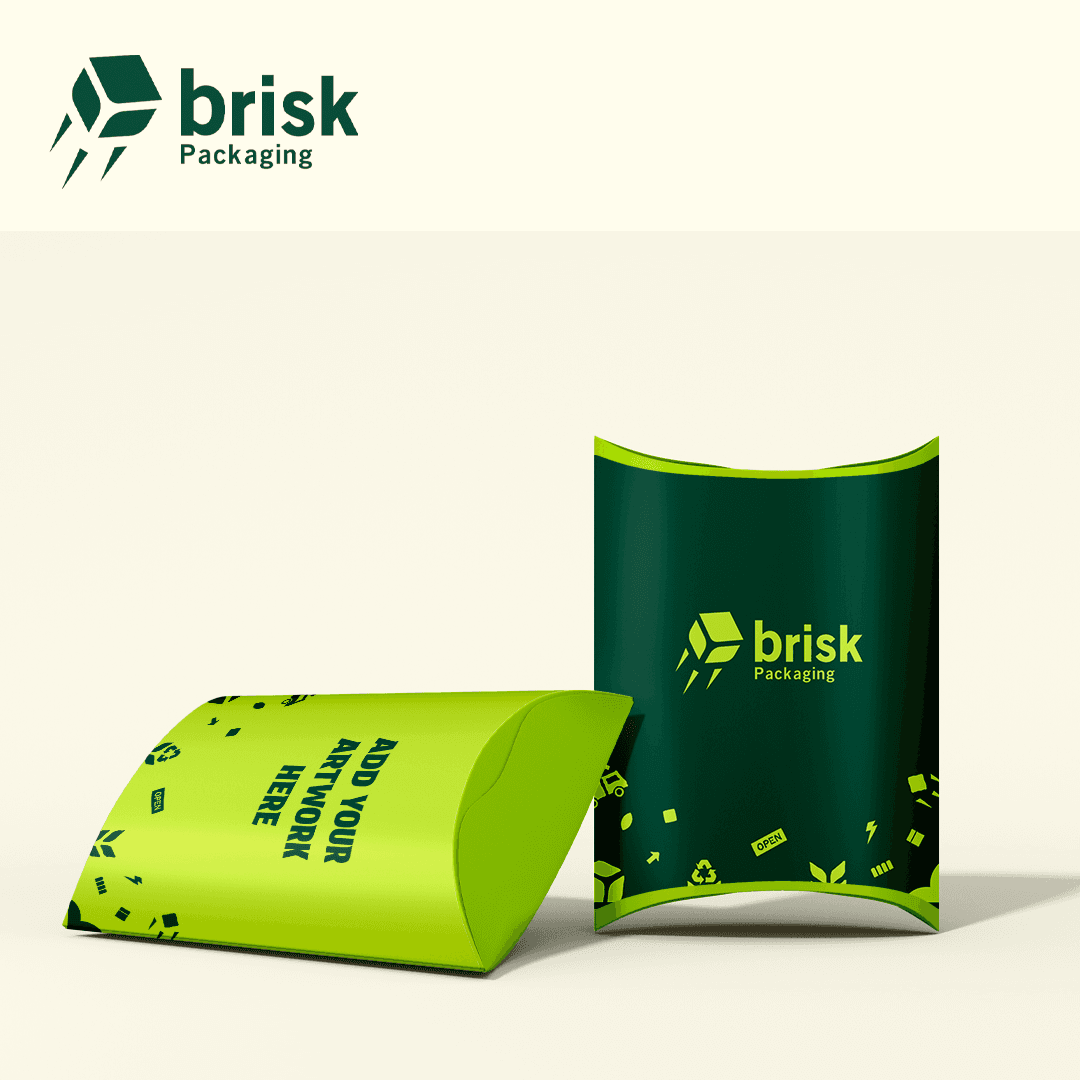
A pillow box is a folding carton whose scored, curved side panels bow outward when the end flaps are folded in. The finished shape resembles a small cushion. Unlike a standard rectangular tuck carton, it has no flat square corners and usually closes through overlapping curved flaps at each end. Most versions arrive flat, take little storage space, and form without a glued setup process at the packing station.
Brisk's live custom pillow boxes category owns the broad commercial query. This guide supports that page by helping buyers decide whether the structure fits the product and by turning a general packaging idea into a quote-ready specification.
The shape offers several practical advantages:
- a recognizable silhouette that differs from ordinary rectangular cartons;
- broad front and back surfaces for logos, patterns, and product information;
- flat delivery and storage before assembly;
- quick closure for many small, lightweight products;
- options for windows, handles, ribbon, labels, and specialty finishes.
Its curved geometry also creates constraints. The usable cavity narrows toward both ends, the carton does not provide a fully flat base, and heavy or sharp products can force the flaps open or distort the panels. The structure should be chosen for fit and function, not appearance alone.
Which products are a good fit?
Pillow packaging often works for jewelry cards, cosmetic samples, soap, small apparel accessories, gift cards, party favors, promotional items, lightweight confectionery in a suitable inner wrap, and compact retail products. The central question is whether the product can sit securely inside the widest part of the package without pushing into the curved closure zones.
Match the specification to the sales channel:
Retail display: Plan the front-facing panel, barcode, price label, product name, and hanging or shelf arrangement. Because a pillow box may rock rather than stand like a rectangular carton, test how stores will merchandise it. A hanging tab, display tray, or counter container may be needed.
Gifts and events: The unusual form can make a small item feel intentionally presented. Ribbon, foil, a belly band, or a personalized message can add detail without requiring a larger rigid box. Make sure decorative elements do not interfere with opening or obscure required information.
Ecommerce: Use the pillow box as primary presentation packaging inside a protective mailer or shipping carton. Its curved paperboard walls usually are not intended to replace a transit-tested outer shipper. Control product movement inside the pillow box and movement of the pillow box inside the parcel.
Food and confectionery: Confirm the complete contact system. A printed folding carton may need an approved inner wrap, pouch, liner, tray, coating, or barrier depending on the food, moisture, grease, temperature, and local requirements. Do not assume that every paperboard or kraft option is suitable for direct food contact.
When should you choose another box structure?
A pillow carton is not automatically the best option for every small item. Compare another structure if the product is heavy, fragile, sharply edged, liquid-filled, unusually tall, or expected to stack under substantial pressure. Products that must remain upright or display a perfectly aligned presentation may be easier to control in a rectangular folding carton, rigid box, or box with a fitted insert.
Choose a different direction when:
- the end flaps bow open under the loaded weight;
- the product needs flat walls on all sides for protection;
- the package must stack neatly in a retail planogram;
- a large instruction panel or regulatory copy needs a flat reading surface;
- the product requires substantial cushioning or a complex insert;
- automated packing equipment cannot reliably form the curved carton;
- the decorative package must also function as the shipping container.
A loaded sample will often settle the decision faster than comparing mockups. Test the pillow structure against one practical alternative using the same product and packing route.
Measure the usable cavity, not just the flat dieline
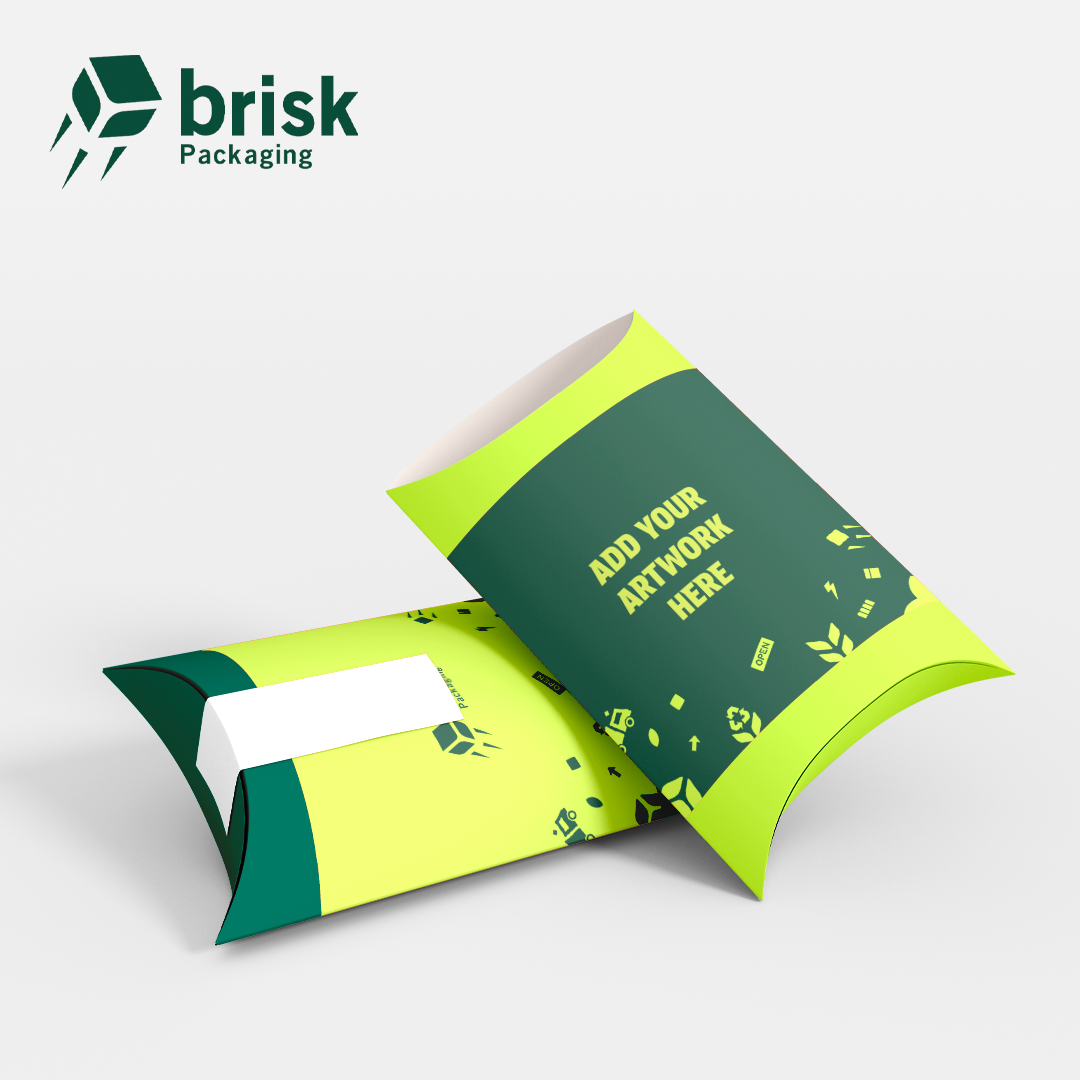
Pillow-box dimensions can be misleading because the carton changes shape during assembly. The widest central section offers the most depth, while the cavity tapers near the curved ends. A product that appears to fit the flat outline may press against a flap, create a visible bulge, or prevent complete closure after the carton is formed.
Prepare these measurements before requesting a dieline:
- maximum product length, width, depth, and weight;
- dimensions of any pouch, card, wrap, tag, or bundled accessory;
- the product's thickest point rather than an average thickness;
- clearance needed to slide the product through an open end;
- space for tissue, padding, an insert, or an information leaflet;
- orientation of the product and the side the customer should see first;
- tolerances caused by handmade products or multiple SKUs;
- master-carton and retail-display constraints.
Do not solve a fit problem simply by adding a large amount of empty space. Oversizing can let the product slide toward the closures and make the package feel underfilled. Undersizing can crease artwork, push open the flaps, or damage the product. If one pillow-box size must serve several variants, test the largest dimensions and the smallest presentation, then use a simple insert, product card, or belly band only when it improves control.
Choose paperboard, coated stock, or kraft deliberately
Material choice affects stiffness, crease behavior, print appearance, scuff resistance, and how easily the bowed shape forms. White coated paperboard is useful for bright process color, photographs, gradients, small type, and a clean retail look. Uncoated or natural kraft creates a warmer material-led appearance, but the brown base changes ink color and reduces contrast for some designs.
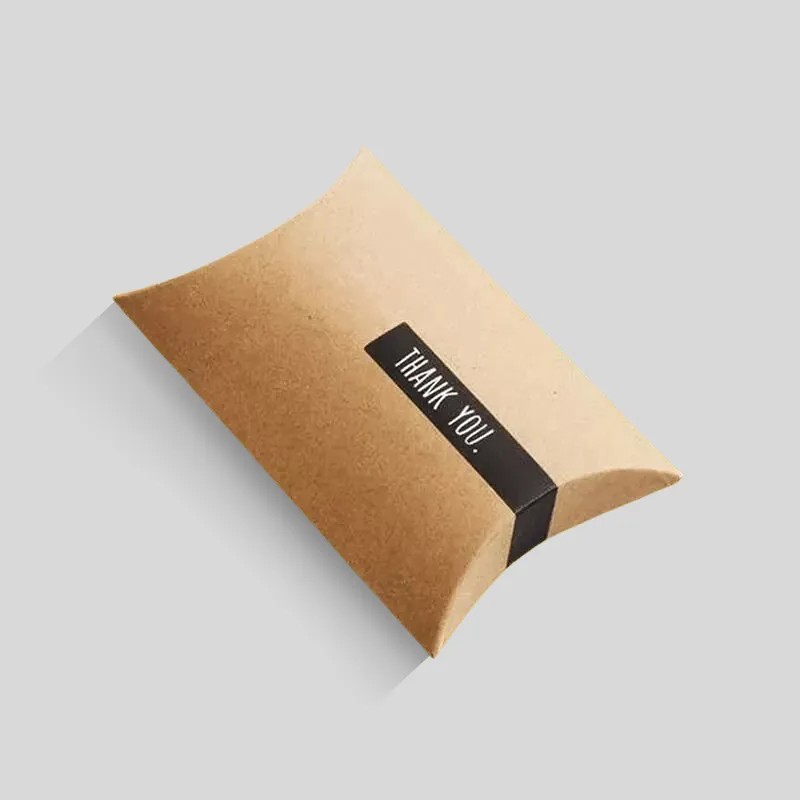
Brisk's custom kraft pillow boxes show a distinct material direction. If you choose kraft, request a printed material sample rather than judging color on a screen. White ink, underprinting, spot colors, and label choices can affect the final result. Sustainability language should be tied to verified material attributes—such as recycled content or a named certification—rather than broad claims based only on a brown appearance.
Board stiffness must suit the finished size and load. A stock that works for a small gift card may collapse or spring open around a thicker product. Heavy board is not always better: if it resists the curved scores, assembly becomes difficult and the surface may crack. Ask the supplier to balance caliper, grain direction, scoring, and coating around the actual carton dimensions.
For moisture, oil, refrigeration, or frequent handling, discuss coatings and barriers early. Material performance is specific to the product environment. A sample made from representative stock is more useful than a generic sample with different caliper and finish.
Engineer end flaps and the opening experience
The curved end flaps create both the pillow shape and the closure. Their overlap, score depth, thumb notch, friction, and board memory affect whether customers can open the package without tearing it and whether it remains closed in handling.
Review these details on the structural sample:
- Can a packer form both curves without crushing the center panel?
- Does the first flap tuck smoothly beneath the second?
- Is the overlap sufficient for the product weight and movement?
- Does a thumb notch make opening easier without exposing the product?
- Will a seal label, tamper-evident feature, ribbon, or belly band be added?
- Can the customer reclose the carton if that matters to the use case?
- Do repeated opening cycles whiten, split, or weaken the curved scores?
Some products require a label or band to prevent accidental opening. That element changes labor, artwork, recyclability, and customer experience, so include it in prototypes and quotes. Avoid relying on an adhesive seal to rescue a structure that is fundamentally overloaded.
Decide whether you need a window or insert
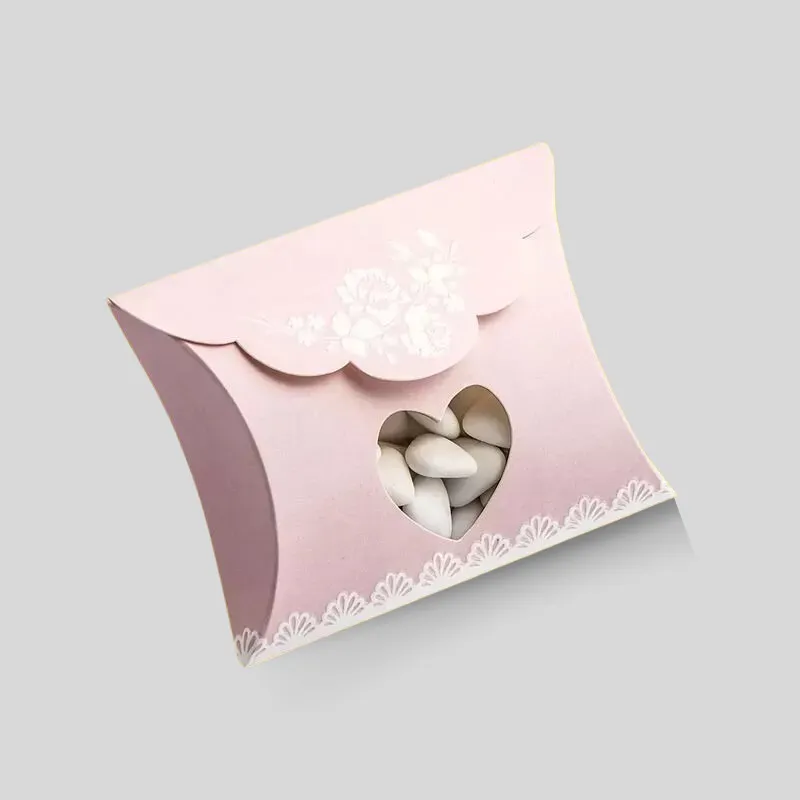
A window can help shoppers see color, texture, or a key product detail, but it removes paperboard from a curved panel and can change stiffness. Brisk's custom pillow boxes with window illustrate this option. Keep the aperture away from active score lines and closure edges, leave enough board around it for strength, and confirm whether clear film is required. If the product can shift away from the opening, pair the window with a card, band, tray, or simple retention feature.
Not every pillow box needs an insert. A closely fitted product card may be enough for earrings or a small accessory. Folded paperboard, tissue, a sleeve, or a lightweight tray can control movement for selected products. Dense foam or a complex multi-part insert may make the pillow structure inefficient; compare a rigid or rectangular box if protection requirements become substantial.
Use Brisk's packaging inserts guide to compare retention options by material and fit. Prototype the insert and outer carton together because added thickness changes the curved cavity and closure pressure.
Plan artwork around curved panels and closure zones
The front and back panels look broad on a flat dieline but bow after assembly. Artwork near the outer curves can appear compressed or be harder to read from the front. Keep the logo, product name, required text, and barcode in tested viewing zones. Do not place important content across curved scores, flap overlaps, window edges, seal areas, or the narrow tapered ends.
A practical panel plan is:
- Primary face: logo, product name, variant, and one clear selling message;
- Reverse face: supporting copy, instructions, barcode, and business details;
- Central side zones: patterns or noncritical design elements that tolerate curvature;
- End flaps: short messages, color blocks, or simple marks that remain legible after overlap.
Before submitting files, review Brisk's packaging artwork preparation guide. Build artwork on the supplier-approved dieline with bleed, safe zones, outlined or packaged fonts, linked images, color mode, and separate layers for cuts, creases, windows, foil, embossing, or Spot UV.
Select printing and finishes for real handling
Digital or offset printing may be appropriate depending on quantity, material, artwork, and color requirements. Ask for the method and proof type instead of assuming that a screen rendering predicts the production result. Solid dark coverage can show crease whitening or scuffs near curved edges. Fine reversed type can fill in on uncoated kraft. Metallic foil and raised effects need enough clear space from scores to apply consistently.
Common finish directions include:
- Matte lamination for reduced glare and a restrained surface;
- Gloss coating or lamination for stronger sheen and vivid graphics;
- Soft-touch finish for tactile presentation, with scuff and fingerprint testing;
- Foil stamping for a controlled metallic logo or accent;
- Spot UV for selective gloss over a contrasting base;
- Embossing or debossing for tactile marks positioned away from active curves.
The matte vs gloss lamination guide provides a focused comparison. Evaluate finish samples on the selected board, then fold and rub them. A finish that looks good flat still has to survive carton forming, packing, transit, and customer handling.
Test packing, transit, and presentation
A pillow carton should be evaluated as a loaded system. First time the manual packing process: opening the flat blank, forming one end, inserting the product, adding any card or tissue, closing the second end, applying a label or band, and placing the carton into the master case. Small delays multiply across a production run.
Then perform practical checks:
- shake and rotate the loaded carton to reveal product movement;
- press the center and ends to identify weak points;
- open and reclose it several times;
- inspect dark print around the curved scores for cracking;
- rub finished cartons together to check scuffing;
- scan the finished barcode on its actual curved panel;
- stack or tray cartons as the retailer will receive them;
- pack them into the ecommerce shipper or master case;
- test representative transit and storage conditions;
- compare samples from the beginning and end of the packing process.
Testing requirements depend on product, channel, destination, and risk. A white structural sample can confirm fit, while a printed production-representative sample is better for color, finish, barcode, and crease review. Record the approved sample and dieline revision so repeat orders use the intended specification.
What changes the cost of custom pillow boxes?
Pricing is shaped by finished size, board and caliper, quantity, print coverage, color method, coating or lamination, die complexity, window shape and film, specialty finishes, insert or band, proof type, assembly labor, individual packing, master cartons, and delivery destination.
Flat storage can reduce space compared with pre-assembled packaging, but that does not make every pillow carton the lowest-cost choice. A window, two specialty finishes, an insert, ribbon, and manual seal may cost more to produce and pack than a simpler rectangular carton. Compare quotes against the same specification and ask what is excluded.
A useful scope comparison is:
- Essential: suitable paperboard, straightforward print, no window, no insert;
- Enhanced: custom print, chosen lamination, product card or seal label;
- Premium: specialty stock, window, foil or tactile detail, fitted retention, and printed sample approval.
Request several quantity tiers without assuming a particular minimum or turnaround. Exact production terms depend on the selected product, specification, and current supplier schedule.
Quote checklist for custom pillow boxes
Send this information to the packaging specialist:
- [ ] Product length, width, depth, weight, photos, and sample availability
- [ ] Product card, pouch, wrap, leaflet, tag, or accessory dimensions
- [ ] Sales channel: retail, gift, event, ecommerce, subscription, or food
- [ ] Required finished size or request for supplier sizing support
- [ ] Product orientation and acceptable movement inside the carton
- [ ] Preferred white board, kraft, specialty paper, or supplier recommendation
- [ ] Food-contact, grease, moisture, temperature, or barrier requirements
- [ ] End-flap, thumb-notch, seal label, ribbon, handle, or reclosure needs
- [ ] Window shape, film, and product-visibility requirement
- [ ] Insert, card, tissue, tray, or belly-band needs
- [ ] Print coverage, brand colors, barcode, and required copy
- [ ] Matte, gloss, soft touch, foil, Spot UV, embossing, or debossing options
- [ ] Quantity tiers, repeat-order expectations, and variant count
- [ ] Manual or automated packing process and desired pack-out
- [ ] White sample, digital proof, printed proof, or production sample
- [ ] Master-carton, shipping route, delivery destination, and target date
FAQ: Custom pillow boxes
What products fit well in pillow boxes?
Pillow boxes generally suit compact, relatively light products such as jewelry cards, samples, small accessories, party favors, promotional items, and selected wrapped confectionery. Fit depends on the central cavity, curved ends, product weight, and closure retention.
How do I size a custom pillow box?
Measure the product's maximum length, width, depth, and weight, including cards, pouches, inserts, and literature. Allow for the cavity taper near both ends and test a loaded structural sample rather than relying only on flat dieline dimensions.
Do pillow boxes ship flat?
Many paperboard pillow boxes are supplied flat and formed during packing. Confirm the exact construction, packing steps, and whether labels, bands, ribbon, or other closure components will be applied.
Are kraft pillow boxes better than white paperboard?
Neither is universally better. Kraft supports a natural material-led look, while coated white paperboard often provides brighter color and finer detail. Compare print samples, stiffness, crease performance, verified material attributes, and the intended brand presentation.
Can a pillow box have a window?
Yes. A die-cut window can reveal the product, with or without clear film depending on the design. Its placement must preserve enough board around curved scores and closures, and the product may need retention so it remains visible.
Do pillow boxes need inserts?
Not always. Close-fitting lightweight items may need no insert, while jewelry, gift sets, or products that shift may benefit from a card, folded board, tissue, sleeve, or small tray. If the insert becomes bulky or complex, compare another box structure.
Can pillow boxes be used for ecommerce shipping?
Use them primarily as presentation packaging inside an appropriate outer mailer or shipping carton unless the complete system has been engineered and tested for direct shipment. Curved decorative paperboard alone may not provide enough transit protection.
Which finish works best on a pillow box?
Choose by artwork, board, handling, and brand direction. Matte reduces glare, gloss adds sheen, foil creates metallic accents, and Spot UV adds selective contrast. Fold and rub representative samples because curved scores can reveal cracking or scuffing.
Request samples, a dieline review, and a quote
Bring Brisk the actual product dimensions, weight, sales channel, material direction, window or insert requirements, artwork, quantity tiers, packing workflow, and delivery destination. A packaging specialist can help compare structural samples and finish options before production.
Browse Brisk's custom pillow boxes and the core custom pillow boxes product, then request a pillow-box sample, approved dieline, material and finish samples, and a configuration-specific quote. A loaded prototype is the clearest way to confirm that the curved cavity, flaps, print, and product presentation work together.