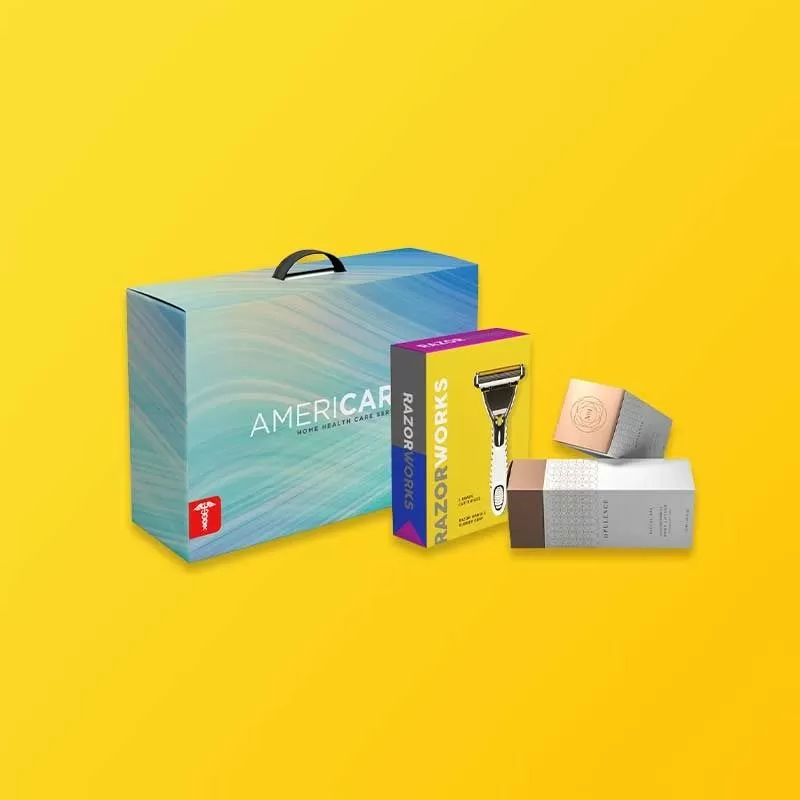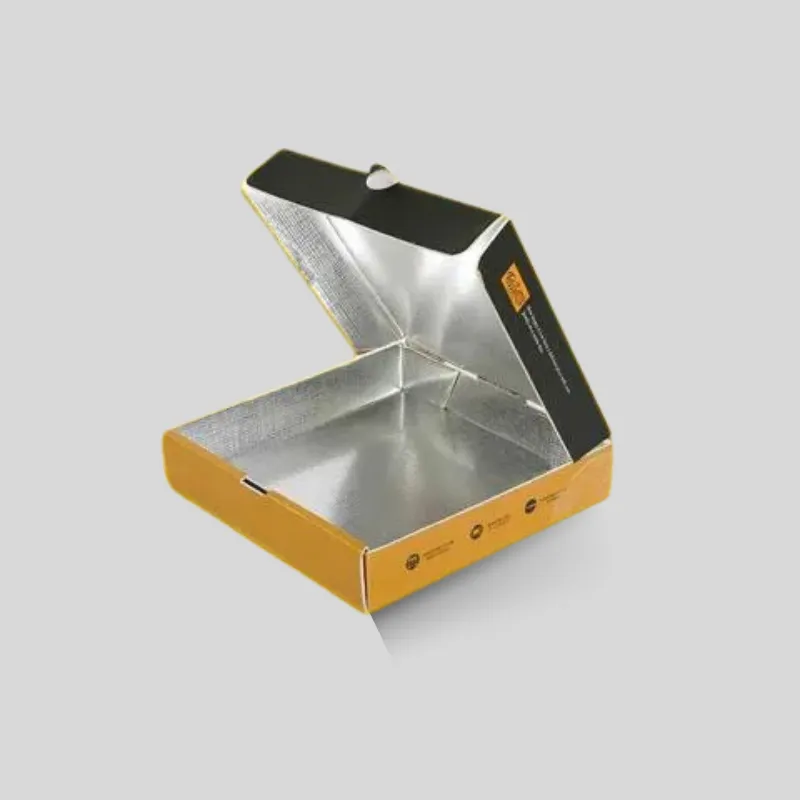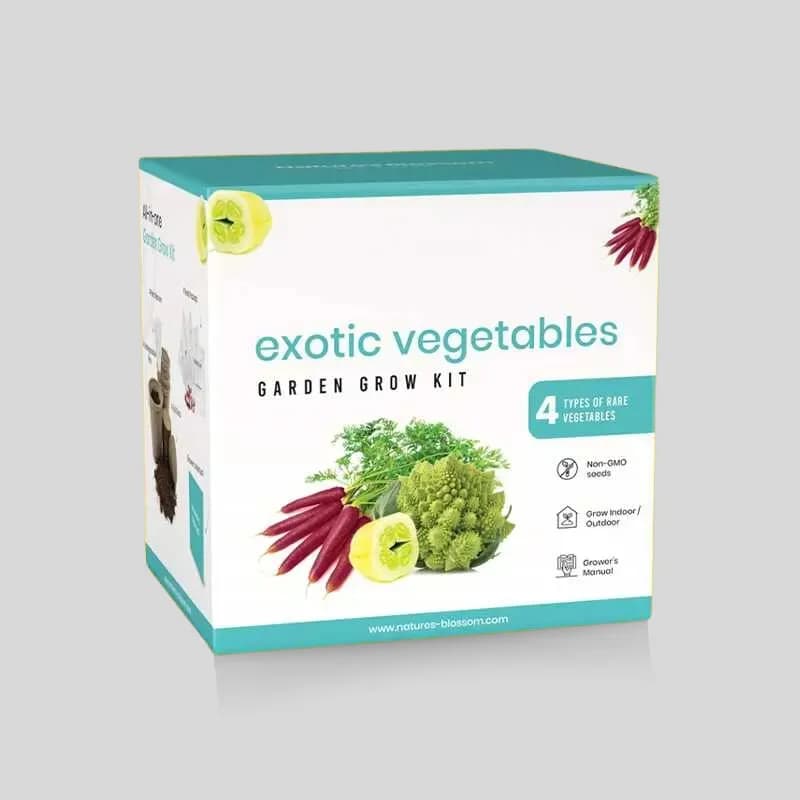
Choose custom vegetable seed boxes only after defining the primary packet or pouch, seed variety, fill quantity, packet count, shelf format, storage route, labeling system, and packing workflow. The printed carton should organize and present the primary packs without bending them, hiding required information, or creating avoidable picking errors. It should not be expected to replace a validated moisture, oxygen, pest, or shelf-life barrier supplied by the primary package and storage system.
Brisk's Custom Vegetable Seed Boxes page is the canonical commercial destination. This guide supports it by helping seed companies, nurseries, garden retailers, and kit brands prepare a better sample request and quotation.
Define the seed product and primary pack first
“Vegetable seeds” can describe a single paper packet, a barrier pouch, a small vial, several varieties in a garden kit, bulk packets for professional growers, or promotional seed packs. Each format creates different dimensions, movement, information, and storage requirements. Begin with production-representative filled packs rather than an empty packet or estimated capacity.
Document these inputs:
- Seed kind and variety, plus the number of SKUs and seasonal versions;
- Primary packet, pouch, envelope, vial, liner, or other immediate container;
- Nominal fill and the realistic thickness range of filled packs;
- Packet count and orientation inside each secondary carton;
- Retail shelf, peg hook, counter display, direct-to-consumer parcel, subscription kit, or wholesale route;
- Storage conditions and the validated barrier and shelf-life responsibilities of each component;
- Lot, test, treatment, barcode, date, traceability, planting, language, and market-specific information requiring review;
- Manual or automated forming, loading, coding, inspection, closing, case packing, and fulfillment steps.
Measure more than one filled sample from normal production. Small seeds may settle into a thin, even layer, while larger seeds can create a lumpy or wedge-shaped packet. Seals, folded headers, labels, hang holes, and closure areas also affect the occupied envelope. A carton based only on flat artwork dimensions may be too tight once real packs are filled.
Separate the primary barrier from the secondary carton
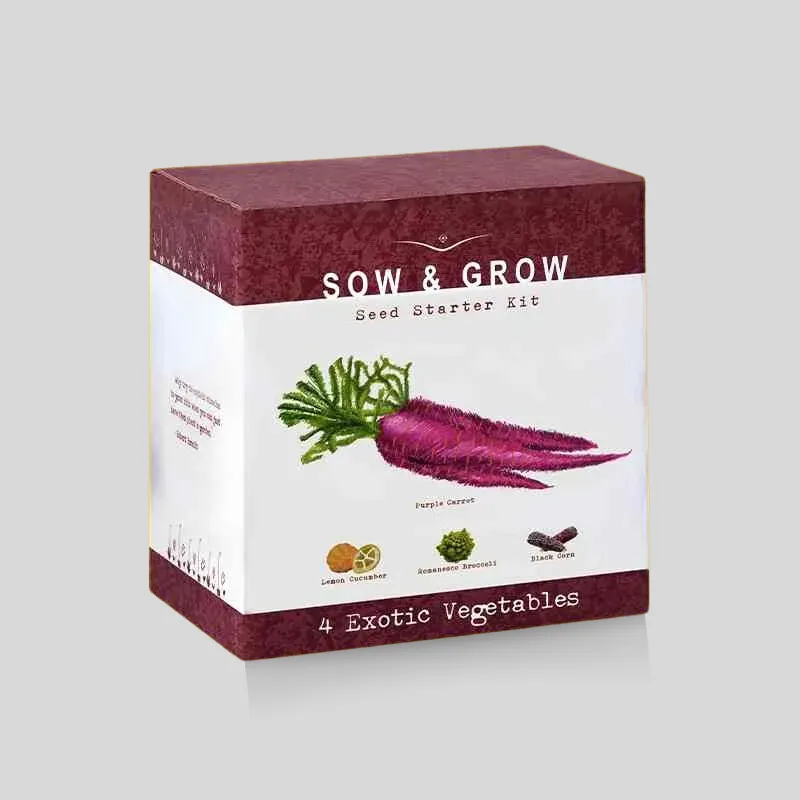
Assign every performance job to a named component. The immediate packet or pouch may provide the required moisture and oxygen barrier. Its seal may control leakage and ingress. The printed paperboard carton may group multiple packets, add communication area, improve shelf presentation, or reduce bending. A corrugated case may handle stacking and distribution. Warehouse controls may manage temperature, humidity, pests, and stock rotation.
Do not assume a coating or thicker carton automatically preserves germination or extends shelf life. Those outcomes depend on seed condition, drying, primary material, sealing, time, environment, handling, and the brand's validated storage program. Ask suppliers for data relevant to the exact material and conditions, then test the complete packed product.
A window can display an inner packet or vial, but it adds another material and cut edge and may reduce panel stiffness. If light exposure matters to the validated system, assess the window rather than choosing it only for appearance. A window also needs enough clearance so inner packs do not snag during loading or rub against the film.
Size the carton around filled packets
Use Brisk's box measurement guide and identify every dimension as internal or external. Arrange the intended packet count in the proposed orientation, including any planting booklet, marker, label sheet, or divider. Measure the maximum loaded length, width, and height without compressing seals or forcing packets to bow.
Allow controlled clearance for loading and normal manufacturing variation. Too little clearance can wrinkle packets, damage heat seals, slow packing, or make the carton bulge. Too much can let packets slump, mix out of sequence, or look underfilled. If varieties must remain in a fixed order, consider a paperboard divider, stepped insert, belly band, or clearly indexed compartments. Test removal so customers can lift one packet without emptying the set.
Panel depth, board caliper, score allowances, glue seam, closure flaps, and insert thickness all affect usable space. The correct dieline must come from the converter after structure and material are selected. Do not stretch artwork from a previous SKU onto a new dieline without checking panels, folds, codes, and safe zones.
Match the structure to retail and fulfillment
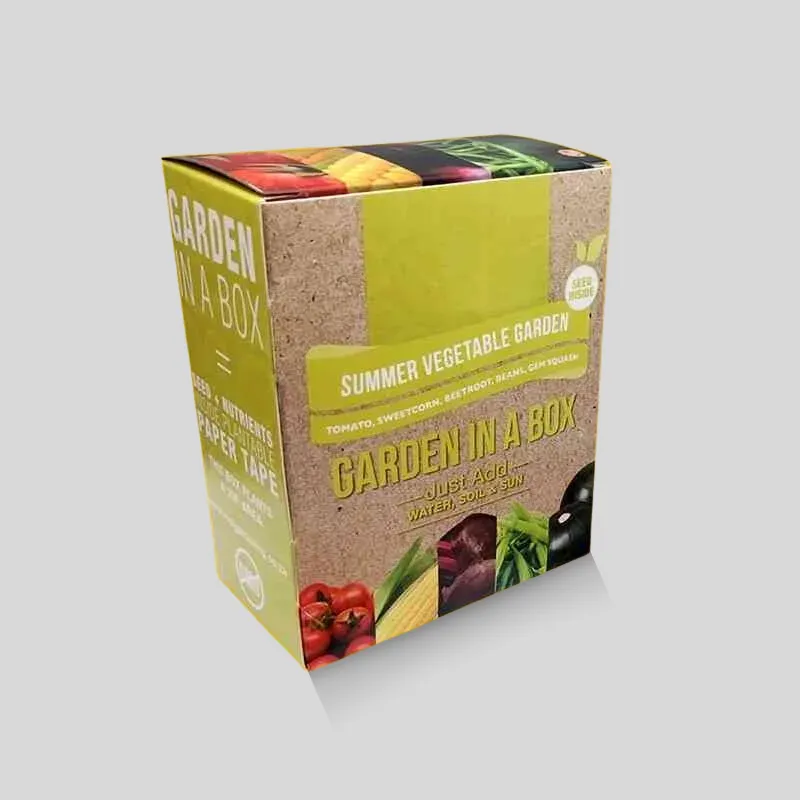
Straight-tuck or reverse-tuck cartons can suit compact packet sets and small containers. They provide several printable panels and ship flat. Confirm which opening faces the shopper and whether repeated opening weakens the tabs during kit use.
Auto-bottom or seal-end cartons may support faster loading or heavier contents when engineered appropriately. Their extra converting and glue operations affect cost, storage, and line setup, so compare them with the actual packing rate rather than assuming they are always better.
Sleeve-and-tray packs can organize curated garden sets and create a deliberate reveal. Test tray friction with the final board and coating. A sleeve that is easy to open in a sample may tighten after print, lamination, humidity exposure, or dimensional variation.
Counter displays and retail-ready cartons can transport packets and then present them at the point of sale. Define tear-away panels, header visibility, remaining strength, replenishment, price-label position, and the number of facings. Prototype the display when full, half full, and nearly empty.
Hang-tab cartons need a reinforced and correctly positioned slot relative to product weight and center of gravity. Check the retailer's hook dimensions and planogram. A top-heavy or off-center pack can tilt, tear, or obscure adjacent products.
Corrugated mailers and master cases provide distribution protection for e-commerce or wholesale routes. Review paperboard versus corrugated packaging when separating the retail pack from the shipper. Do not assume a folding carton alone is carrier-ready.
Choose board, printing, and finishes deliberately
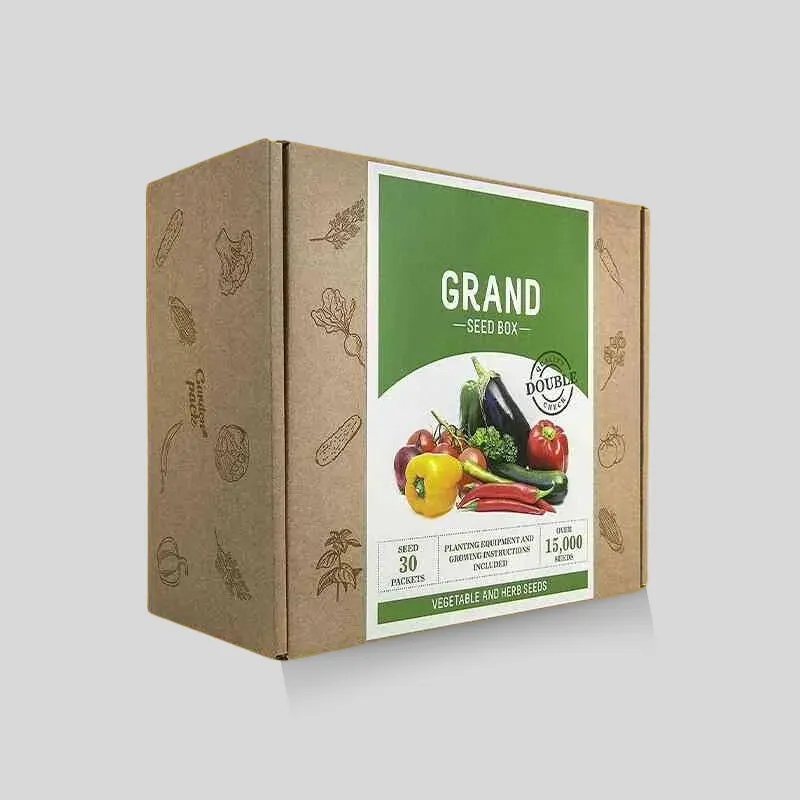
Brisk's verified product data lists kraft paper, recycled cardboard, and SBS paperboard as available directions for its vegetable seed boxes. Kraft creates a natural brown base that changes ink appearance and unprinted areas. Recycled board can support a material story when the exact construction and evidence match the claim. SBS provides a smooth white surface for detailed color, small type, crop imagery, and organized information. Final grade and caliper should follow size, load, folds, display method, stacking, and testing.
CMYK printing can reproduce crop photography and multi-color ranges. Spot colors may help control important brand or variety colors, but appearance still changes with substrate, ink, coating, and process. Use names, codes, symbols, and hierarchy in addition to color so similar varieties are not distinguished by hue alone. Approve a proof on the proposed material.
Brisk's product record also identifies aqueous coating, matte lamination, embossing, die cutting, and window patching as possible customization directions. Select finishes for a specific function or hierarchy. A coating may improve handling resistance; embossing can emphasize a mark; a die cut can create access or display features. Each choice can affect folds, scuffing, writing or coding areas, material separation, and price.
Environmental claims should describe the complete finished pack, not only one board. Lamination, window film, labels, adhesives, inks, inserts, and local collection systems all matter. Request component-level evidence and avoid unsupported claims such as “fully recyclable,” “compostable,” “plastic free,” or “zero waste.”
Plan labeling, planting information, and SKU control
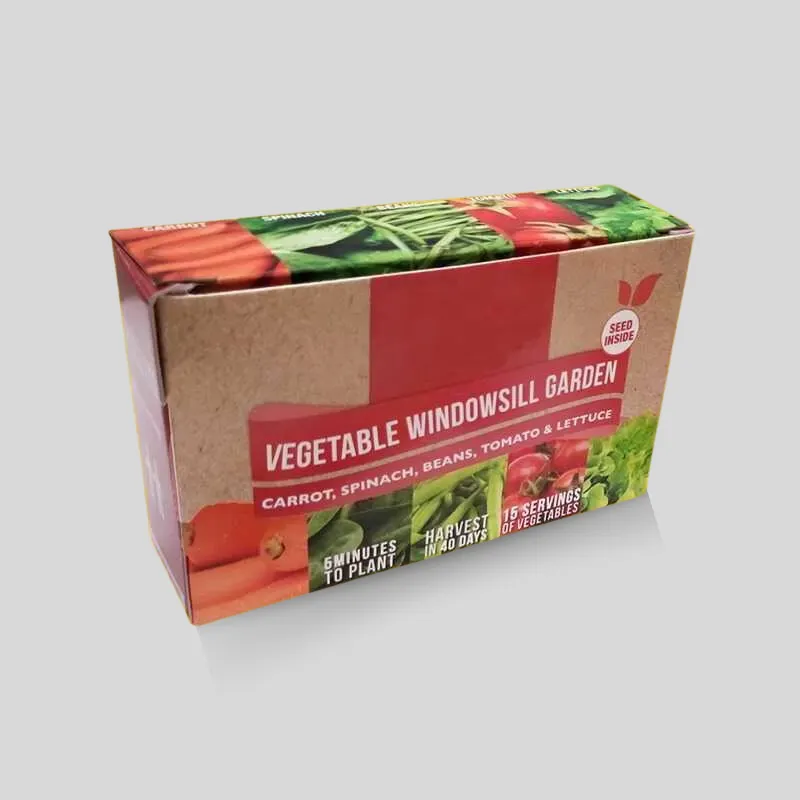
Reserve information space before decorating the carton. In the United States, USDA's Federal Seed Act resources identify subjects such as seed identity, purity, germination, noxious weed seed, treatment, and interstate shipper information in applicable circumstances. Requirements vary by seed type, pack size, treatment, claims, route, state, and destination. Other markets have their own rules. Use qualified legal and regulatory reviewers to determine what applies; this article is not a universal labeling checklist.
Map permanent branding separately from variable information. Variety name, lot identification, test or pack information, treatment statements, barcode, price, language, planting zone, sowing depth, spacing, harvest guidance, and QR destination may change on different schedules. Decide whether each element belongs on the immediate packet, secondary carton, applied label, insert, or controlled code area.
Use the approved production dieline and Brisk's artwork preparation guide. Protect bleed, safe zones, folds, glue areas, barcodes, small type, windows, hang holes, and variable-print fields. Create a proof matrix listing every SKU and the expected variety, crop image, code, packet count, market, language, and revision. Require named approval ownership rather than relying on visual similarity.
QR codes should add useful content, not carry information that must remain available without a phone. Verify destination ownership, mobile usability, contrast, quiet zone, printed size, and scans from production samples. Plan how links will be maintained after inventory enters distribution.
Prototype the complete workflow
A useful sample tests packing, display, opening, storage, and shipment—not only graphics.
- Form the carton in the proposed board and finish.
- Load production-representative filled packets across normal thickness variation.
- Add all dividers, booklets, markers, labels, and promotional components.
- Apply lot/date codes and scan barcodes or QR codes from typical positions.
- Check bulging, packet bending, seal contact, closure security, and squareness.
- Place the carton on its shelf, hook, counter display, or kit configuration.
- Open and remove packets in the intended sequence.
- Pack retail units into the proposed mailer or master case.
- Run distribution and storage tests appropriate to the actual route.
- Reinspect primary seals, print, codes, packet order, and carton condition.
Observe packers and retail staff. A closure that takes two attempts, a divider that flips during loading, or nearly identical SKUs stored side by side can create recurring errors. Revise the structure and work instructions before committing to printed inventory.
What affects vegetable seed box cost?
Cost depends on finished dimensions, board grade, quantity, structure, print process, ink coverage, number of SKUs, proofing, coatings, windows, inserts, coding needs, tooling, assembly, packing, master cases, freight, and destination. Small cartons are not automatically inexpensive: many versions and short seasonal runs can add setup and inventory complexity.
Request quantity tiers for one controlled specification and compare suppliers on equivalent scope. MOQ, production timing, and pricing vary by project, so rely on a written quote rather than a generic website claim. Ask whether the quote includes proofs, tooling, inserts, assembly, individual bundling, case packing, and freight.
Control complexity by sharing a structural footprint across compatible varieties, using a disciplined artwork template, reserving a variable-label area, or grouping stable volumes. Do not remove required information, validated barrier layers, necessary identification, or distribution protection simply to reduce unit cost.
Quote checklist for custom vegetable seed boxes
- [ ] Seed kind, variety, fill, packet count, and production-representative samples
- [ ] Primary packet, pouch, vial, seal, and validated barrier responsibilities
- [ ] Internal dimensions, orientation, clearance, and thickness variation
- [ ] Tuck carton, sleeve, display, hang-tab, kit, mailer, and master-case needs
- [ ] Board, caliper, print process, coating, window, insert, and finish
- [ ] Retail, nursery, e-commerce, subscription, wholesale, and storage route
- [ ] Required and reviewed variety, lot, test, treatment, barcode, and business information
- [ ] Planting instructions, languages, QR destination, and accessibility hierarchy
- [ ] SKU matrix, quantity tiers, seasonal versions, and revision ownership
- [ ] Forming, loading, coding, inspection, closure, and case-packing workflow
- [ ] Plain sample, printed proof, testing plan, destination, and target date
FAQ: Custom vegetable seed boxes
What is the best material for vegetable seed boxes?
There is no universal best board. SBS can support detailed graphics and small text, kraft offers a natural brown appearance, and recycled board may fit some material strategies. Select grade and caliper after testing size, load, folds, display, storage, and distribution. The primary packet must still provide its validated seed-protection functions.
Should the carton provide the moisture barrier?
Do not assume a standard printed carton is the moisture barrier. Define the barrier role of the primary packet or pouch, seals, carton, case, and storage environment, then validate the complete system for the actual seed and route.
How much clearance do filled seed packets need?
Enough for repeatable loading and normal packet variation without bending seals or bulging panels, but not so much that packs slump or lose order. Measure multiple filled packets and approve a physical sample; do not use one generic clearance for every seed format.
Can several seed varieties share one carton size?
Yes, when their filled dimensions, count, protection, information space, and workflow are compatible. Use a controlled SKU matrix and proof process so shared structures do not cause artwork, barcode, or variety mix-ups.
What information belongs on a vegetable seed box?
That depends on product, pack size, treatment, claims, sales route, and jurisdiction. Identify required information with qualified reviewers and coordinate the primary packet, secondary carton, labels, and inserts so the complete package is accurate and usable.
What should I send for a seed-box quote?
Send filled production samples, packet count and variation, proposed structure, internal dimensions, board and finish preferences, SKU matrix, reviewed copy, display and shipping route, quantity tiers, packing workflow, testing needs, destination, and schedule.
Request a seed-box sample and quote
Bring Brisk filled packets, the SKU matrix, reviewed information plan, internal dimensions, board preferences, display method, quantity tiers, packing workflow, and distribution route. A packaging specialist can help compare tuck cartons, sleeves, displays, paperboards, windows, coatings, and inserts while keeping the product page as the transactional owner.
Review Brisk's Custom Vegetable Seed Boxes, then request a sample, dieline review, and a custom quote. Approve production only after the filled primary packs, carton, codes, display, storage, and shipping system have been tested and reviewed for the intended market.