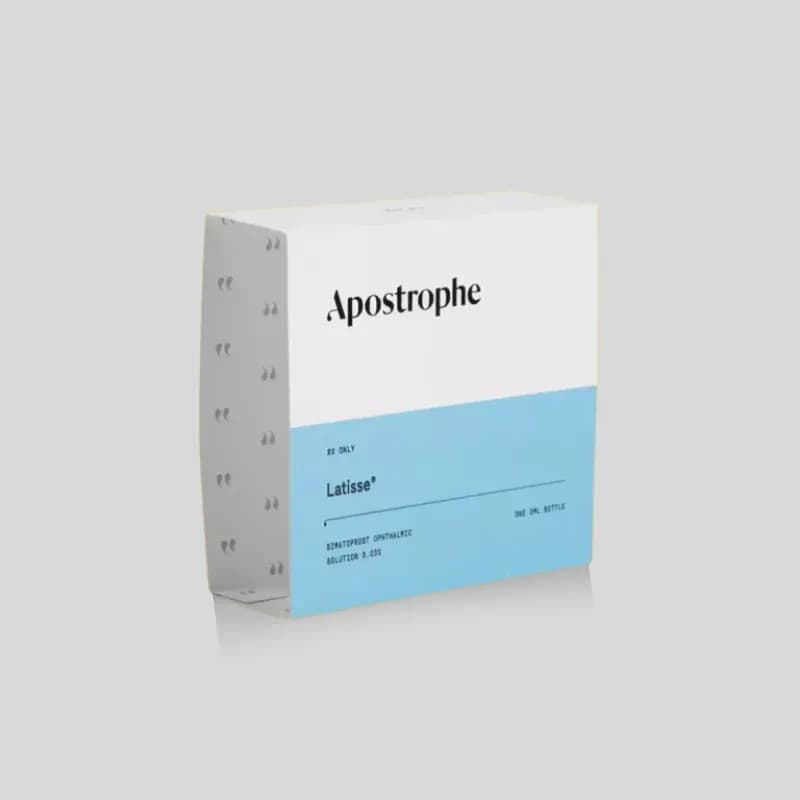
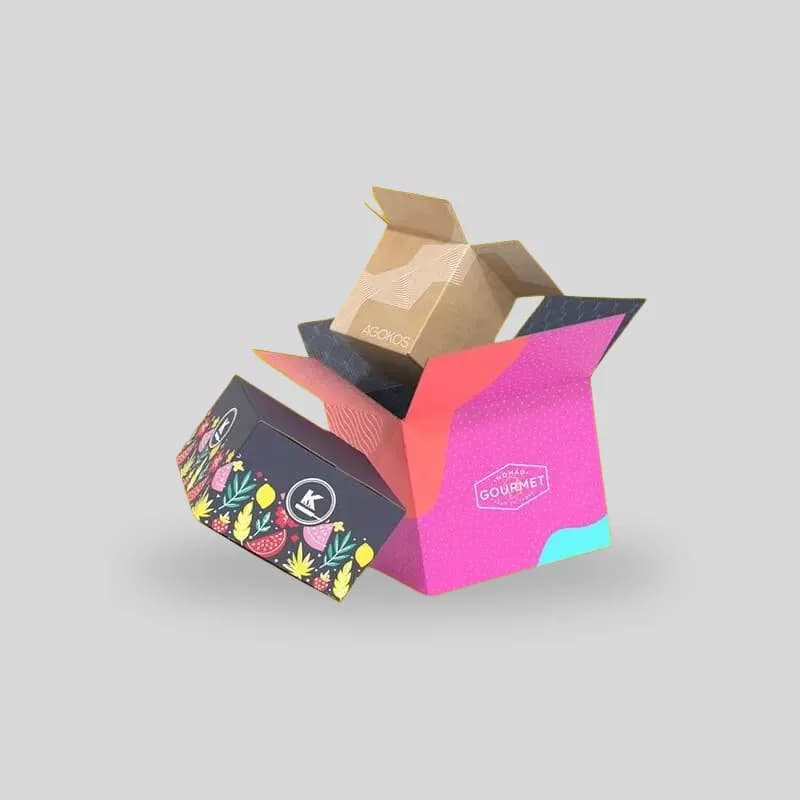
A shelf full of stacked product units does not sell itself. Retailers know this — and so do brands that routinely see lift when products move from a back shelf to a branded counter display positioned at the register. Custom display boxes are the structural format that makes that placement happen: a self-contained tray, tray-with-header, or floor stand that holds multiple units in a fixed arrangement and carries your brand graphics without requiring a permanent fixture from the retailer.
If you are sourcing display packaging for the first time or evaluating an upgrade, this guide covers every structural type, the material choices behind each, how to spec dimensions and divider configurations, print and finish options that hold attention at point of purchase, and what your vendor needs to quote accurately.
What Custom Display Boxes Are (and Are Not)
A custom display box is a secondary packaging structure — it contains multiple individual product units for presentation at retail. Unlike standard shelf packaging, a display box is designed to be placed as-is by store staff: the box, graphic, and product arrangement are the display. No separate fixture, no planogram change required by the retailer.
Display boxes are different from:
- Individual product boxes — the carton around a single unit. Display boxes hold groups of those units.
- Window boxes — a single-unit retail carton with a transparent panel. A display box may contain window-box units, but it is not itself a window box.
- Shipper boxes — plain corrugated cartons for transit protection only. Some display boxes ship flat and convert to shipper-display combos, but their design priority is presentation, not transit strength alone.
The distinction matters because your brief and dieline requirements, material grade, and retail approval documents all depend on the correct structural category.
Types of Custom Display Boxes
Counter / PDQ Tray
A PDQ (Pretty Darn Quick, or Product Display Quickly) tray sits on a retail counter, end-cap ledge, or checkout area. Units load from the front or top and face forward. Counter displays are typically 6–48 unit capacity with a low profile (under 300 mm tall) so they do not block sightlines across the counter.
Counter trays are the highest-velocity format for impulse items: lip balms, single-serve snacks, branded accessories, and promotional bundles. Their compact footprint makes retailer sell-in easier because they displace minimal counter space.
Header Card Display
A header card display is a PDQ tray or counter tray with an integrated printed header panel rising above the product bay. The header extends the vertical branding surface above unit height, allowing a hero product image, QR code, and promotional messaging without increasing floor or counter footprint.
Header cards are die-cut from the same parent sheet as the tray base, scored and folded into position, or glued as a separate panel. Your dieline file must specify the header panel dimensions, perforation lines for easy removal by store staff, and any slotted hanging holes if the retailer requires peg-bar hanging as an alternative placement.
Shelf-Ready Packaging (SRP)
Shelf-ready packaging is designed to go directly from the shipping carton onto the shelf in a single motion — staff tear or cut a perforated opening and slide the display tray into the shelf bay. SRP is also called retail-ready packaging (RRP).
SRP is common in grocery, pharmacy, and convenience-store channels because it reduces stocking labour. Retailers in these channels often have SRP specifications — tray height, opening force, and label placement requirements — that your artwork must satisfy before approval.
Corrugated Floor Stand and Power Wing
For higher unit-count displays (48–200+ units) or bulkier products, a corrugated floor stand (also called a floor display or FSDU — free-standing display unit) provides multi-tier shelving on a self-supporting structure. Power wings attach to an existing display or gondola end-cap and add a side-facing panel of product.
Floor stands are common in sporting goods, pet supplies, home improvement, and seasonal promotional programmes. They ship flat-packed and assemble without tools; assembly instructions must be accurate on the first attempt, so prototype testing before full production is standard practice.
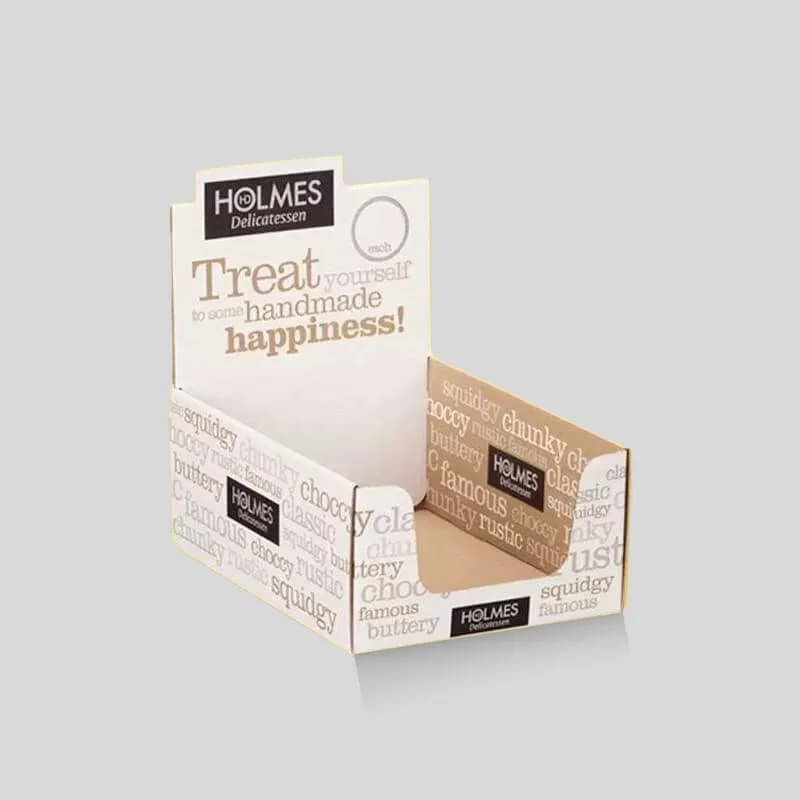
Material Comparison: Choosing the Right Board Grade
Display box material determines structural rigidity, print fidelity, moisture resistance, and shipping performance.
| Material | Thickness | Print surface | Best for | Limitation |
|---|---|---|---|---|
| SBS paperboard (18–24 pt) | 0.45–0.61 mm | Excellent: smooth, vibrant litho | Counter trays, header displays, lightweight gift-with-purchase | Not for heavy or moist product loads |
| E-flute corrugated | ~1.6 mm | Good: litho-laminate face sheet | Light-to-medium counter and shelf displays | Less rigid than B-flute for tall structures |
| B-flute corrugated | ~3.2 mm | Fair: flexo direct or litho-laminate | Floor stands, heavier products, transport-display combos | More visible flute texture on direct print |
| F-flute corrugated | ~0.8 mm | Very good: litho-laminate face sheet | Premium counter displays needing flat appearance | Slightly less crush resistance than E-flute |
| Double-wall (BC-flute) | ~7 mm | Fair | Heavy-load floor stands, outdoor events | Bulkier; adds shipping weight |
Practical guidance: For branded counter displays with full-colour printing, SBS paperboard or F/E-flute corrugated with a litho-laminated face sheet consistently produce the cleanest graphics. For floor stands holding products over 1 kg per shelf, B-flute or BC-flute is the safer structural choice. Brisk can provide material test reports for specific loading requirements on request.
Specifying Dimensions and Cell Configuration
Accurate dimension specs prevent the most common display-box problem: units that rattle, tip, or fall forward during stocking. Provide your vendor with:
- Outer footprint: Width × Depth of the display tray base (the retailer's counter or shelf space constraint)
- Display height: From tray base to top of header panel (if present); counter displays typically 150–300 mm tray depth, floor stands 900–1,800 mm total
- Unit pocket dimensions: Inner width × depth × height per cell, based on your individual product unit dimensions plus clearance tolerance (typically 3–5 mm per side)
- Cell count and arrangement: e.g., 4 columns × 3 rows = 12 units; rows may be staggered or level
- Load weight per shelf tier: Total product weight in display at full facing
- Tray wall height: Minimum height required to retain product (typically 30–50 % of unit height)
If you do not have a confirmed retailer shelf spec, Brisk's packaging specialists can reverse-calculate tray dimensions from your product unit dimensions and target facing count.
Divider and Insert Configurations
Dividers separate individual unit pockets within a display tray. They serve three purposes: structural rigidity (the divider grid stiffens the tray base), product protection (prevents units from colliding in transit), and visual hierarchy (clean rows of product face forward uniformly).
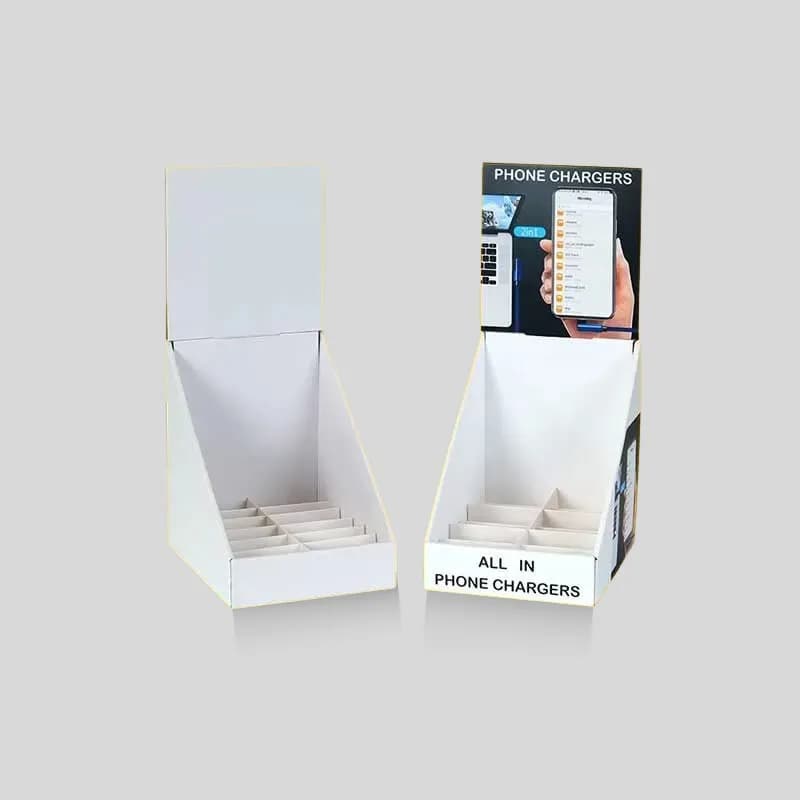
Divider configurations include:
- Tab-lock partitions — corrugated or paperboard dividers that slot into each other without adhesive; easy to assemble, adjustable
- Glued partition assembly — pre-glued grid ships flat and opens into position; faster setup for high-volume packing lines
- Foam padding channels — used for fragile products (glass bottles, electronics accessories) where corrugated partition contact alone is insufficient
- Tiered shelf inserts — angled platforms within a floor-stand tier that gravity-feed product forward as front units are taken (also called gravity-feed tilted shelves)
For products that vary in facing configuration by SKU, Brisk can design a universal tray with an adjustable partition depth so a single dieline serves multiple SKU footprints.
Printing and Finishing Options
Display boxes carry brand graphics on multiple panels — front, sides, and header card — so print quality directly affects the display's retail ROI.
Printing methods:
- Litho laminate: A high-resolution litho-printed paper sheet is laminated to the corrugated or board substrate. Best colour fidelity; cost-effective at medium to high volumes.
- Digital direct print: Inkjet printing direct to box; cost-effective for short runs and variable data (promotional codes, regional copy). Slightly lower resolution than litho.
- Flexo direct print: Spot-colour or process flexo on corrugated; good for large B-flute floor stands where text legibility is the priority over photographic image quality.
Finishing options:
- Gloss or matte laminate: Protects surface, sets visual tone (gloss for premium/luxury, matte for clean/modern aesthetic)
- Spot UV: Selective high-gloss coating applied over matte substrate; highlights logo, product image, or call-to-action panel
- Soft-touch laminate: Velvety tactile finish; commands premium perception at retail
- Foil stamping: Hot or cold foil on header card for premium brand positioning
Finishing adds cost; prioritise it on the header card and front panel where shopper eyes land first. Side and back panels may use a uncoated or matte-only finish without meaningful impact on sell-through.
Display Boxes in Your Packaging Line
If your packing operation fills display trays on a line rather than by hand, confirm:
- Flat-ship knock-down (KD): Can the display tray erect on your packing equipment, or does it require manual setup?
- Auto-lock base integration: Counter display trays are often specified with crash-lock (auto-lock) bases so they erect instantly on a high-speed line. This is different from the display's retail function — it is a production-efficiency feature.
- Stacking strength: If finished filled displays are palletised and transported to retail DCs, specify required edge-crush test (ECT) or box compression test (BCT) values so the substrate is sized correctly.
Discuss line speed and erection method with Brisk at the quote stage — these details affect base style, glue placement, and board grade selection and are much cheaper to resolve before tooling than after.
MOQ, Lead Time, and Cost Factors
Display-box pricing is a function of:
- Structure complexity — flat tray vs tray-with-header vs multi-tier floor stand; each adds tooling and assembly steps
- Material grade — SBS vs corrugated; face-sheet laminate vs direct print
- Printing method and coverage — full four-colour litho vs two-colour flexo spot
- Finishing — laminate, spot UV, foil each add to unit cost
- Quantity — lower MOQs carry higher per-unit costs due to tooling and set-up amortisation
- Cell configuration — glued partition assemblies add labour cost vs tool-free tab-lock designs
Typical MOQs for custom counter display trays start at 500–1,000 units for paperboard; corrugated floor stands often have lower unit counts but higher die-tooling costs. Brisk will specify tooling separately from unit cost on your quote so you understand break-even volume.
Lead time from approved artwork to delivered product is typically 10–18 business days for standard board grades; litho-laminate and specialty finishes may add 3–5 business days.
Quote Checklist: What Brisk Needs from You
Providing complete information at the quote stage eliminates back-and-forth and accelerates artwork approval:
- Product unit dimensions (W × D × H) and weight per unit
- Target facing count (number of units on display at full stock)
- Retailer counter or floor space constraint (available footprint)
- Distribution channel (grocery, pharmacy, specialty, DTC pop-up)
- Shipping method and pallet configuration (if display ships loaded)
- Preferred material and print method, or open to recommendation
- Annual volume and initial order quantity
- Artwork files (or request a 3D design from Brisk's team)
- Any retailer-specific compliance specs (SRP opening force, peg-hole requirements)
Ready to specify your display? Brisk's packaging specialists provide a free custom 3D digital display design and vector dielines within 24–48 hours — you see exactly how the display presents your product before committing to production. Request your free 3D display design today.
FAQ: Frequently Asked Questions
What is the difference between a PDQ tray and a counter display box?
PDQ tray and counter display box refer to the same format — a low-profile tray that holds multiple units on a counter or shelf end-cap for quick shopper selection. PDQ stands for "Pretty Darn Quick" or "Product Display Quickly," referring to how fast store staff can set up the display.
What materials are used for counter display boxes?
Counter displays are most commonly made from SBS (solid bleached sulphate) paperboard (16–24 pt) or E-flute or F-flute corrugated board with a litho-laminated face sheet. SBS provides the cleanest print surface; corrugated adds structural depth for heavier products or taller header card designs.
What is the minimum order quantity (MOQ) for custom display boxes?
MOQ varies by structure and material. Standard paperboard counter trays typically start at 500–1,000 units. Corrugated floor stands may start at 250–500 units but carry tooling costs. Brisk will quote MOQ and tooling separately so you can evaluate initial versus repeat-run economics.
Can display boxes be designed to also serve as the shipping carton?
Yes. Shipper-display (also called retail-ready or shelf-ready packaging) is a corrugated carton engineered to survive transit and then convert to the retail display by tearing a perforated opening. B-flute or E-flute with reinforced edges is the typical specification. Brisk designs these to retailer SRP compliance specs on request.
How are dividers installed in a display tray?
Most display-box dividers are included as a flat-pack partition assembly that slots or glues into position. Tab-lock partitions assemble without adhesive in seconds. Pre-glued assemblies ship ready to erect — appropriate for high-volume packing lines. Foam-insert pads are supplied pre-cut and drop in without tools.
How long does production take for a custom display box order?
Standard SBS or E-flute counter display trays: 10–15 business days from approved artwork. Litho-laminated corrugated floor stands or multi-tier units: 14–20 business days. Rush programmes may be available — ask Brisk's team at the quote stage. 3D digital design and dielines are delivered within 24–48 hours before production begins.
Do I need to provide artwork, or can Brisk design the display?
Both paths are available. If you have brand guidelines and artwork files (AI, PDF, or high-resolution PSD at 300 dpi), Brisk's team will apply them to the structural dieline. If you need a design from the start, request a free 3D digital design — Brisk's designers create a photorealistic preview of your display before you approve for production.