Choose custom donut boxes by measuring the finished donuts, grouping compatible toppings, selecting a count and layout from real orders, and testing grease control, clearance, movement, stacking, and delivery. Do not rely on a generic “standard donut” label. A ring donut, filled donut, long bar, mini donut, and heavily topped specialty donut can require different internal dimensions and handling. Approve a physical sample packed with the most demanding assortment before production.
Brisk's Custom Donut Boxes page is the commercial destination for branded donut packaging. This guide helps bakeries, cafés, caterers, food trucks, and packaging buyers prepare a more accurate specification for samples, dielines, and quotes.
1. Measure finished donuts, not the cutter
The box has to accommodate the product after proofing, frying or baking, cooling, filling, glazing, icing, and decorating. Cutter diameter or an unfilled shell does not capture the final footprint. Glaze can extend beyond an edge, crumb and nut toppings add irregular height, and a filled donut may be taller or softer than a plain ring.
Measure several production-representative donuts from each important product family. Record:
Maximum finished width and length;
Height at the center and highest topping;
Shape, including round, bar, twist, filled, or mini;
Approximate weight and softness;
Whether icing or glaze remains tacky at packing;
Loose sugar, crumbs, nuts, or decorative pieces;
Expected size variation between batches;
Packing temperature and cooling time;
Whether the product is placed directly on board, on a liner, or in a cup;
Expected time from packing to customer opening.
Use internal box dimensions when checking fit. Brisk's guide to measuring a box for custom packaging explains the length, width, and height sequence. Add deliberate clearance rather than guessing. Too little height can press toppings against the lid or window. Too much open space can let donuts slide, collide, or rotate during delivery.
Build the sample around the hardest realistic order. If a dozen box may contain tall filled donuts, sticky glazed rings, and decorated specialty pieces, test that combination—not only twelve plain rings arranged perfectly on a table.
2. Classify the assortment before choosing one box
A bakery may want one package for inventory simplicity, but one structure does not automatically suit every SKU. Group donuts by dimensions, surface sensitivity, grease level, and handling needs. Plain cake donuts may tolerate closer spacing than iced donuts with soft decorations. Powdered products may transfer dust to windows and neighboring items. Filled products can be less stable when placed on an edge or squeezed by a tight row.
A practical assortment matrix can have columns for product family, maximum dimensions, topping type, count sold, delivery channel, liner or cup, and box format. This reveals which items can share a specification and which require a different height, layout, or packing rule.
Do not assume stacking is safe merely because it increases capacity. Direct stacking can mark glaze, flatten toppings, transfer flavors, or make removal messy. If the bakery deliberately stacks compatible products, test the exact arrangement and contact surfaces. Otherwise, use a single layer or a supplier-reviewed tray/divider system that preserves clearance.
3. Choose count and layout from actual orders
Brisk's live product record lists 6-, 12-, and 24-count options, but those are starting points rather than a universal program. Review sales by count, product family, channel, and season. Single or pair formats can suit counter purchases and favors. Six-count packs may serve tasting assortments or smaller households. Dozen and larger formats can fit office, event, and catering orders when the package remains practical to carry and stack.
Map the inside of the box before locking dimensions. A grid is simple, but alternating or separated layouts may use space differently. Allow room for the widest product and for a staff member to place and remove it without scraping icing against the wall. Consider whether customers will lift donuts with fingers, a paper tab, cup, or utensil.
For mixed assortments, create packing diagrams. Mark where tall, fragile, powdered, or heavily iced items belong. A repeatable diagram helps staff avoid improvising during rush periods and gives the structural test a consistent load.
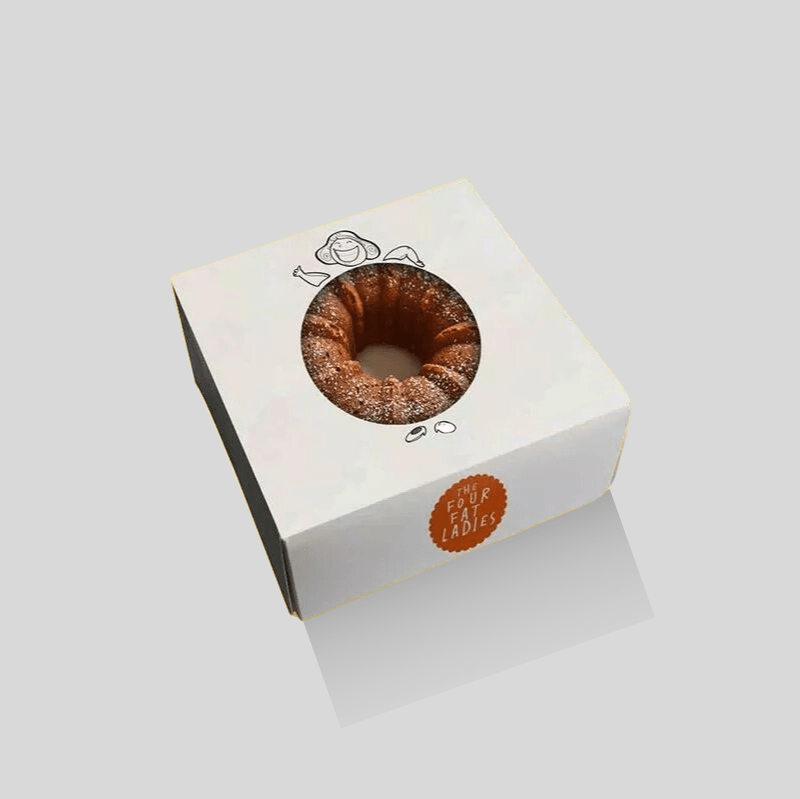
Check the loaded footprint as well as the nominal count. A 24-count box can become wide and flexible; a long span may need stronger board, reinforcement, or a different handling plan. Larger is not automatically more efficient if it slows packing, occupies excessive shelf space, bends when lifted, or cannot fit the normal delivery bag and vehicle shelf.
4. Control grease, glaze, crumbs, and movement
Donut packaging has several separate control tasks. Grease resistance addresses oil migration into the board. A liner can create a removable contact layer and simplify cleanup. Clearance helps prevent icing and toppings from touching the lid. Dividers, cups, or a closer layout can reduce movement. Venting and closure influence the environment inside the pack. No single coating or insert solves all of these jobs.
Ask the supplier to define the complete food-contact system: carton board, interior print, coating, liner, adhesive, window film, insert, and any cup that touches the product. Suitability depends on the intended food, temperature, contact duration, destination, and applicable requirements. Avoid treating “food packaging” as automatic approval for every direct-contact use.
Grease tests should use the bakery's oiliest production-representative donut at the actual packing temperature and expected hold time. Place it in the complete pack, not on a loose board swatch only. Inspect the base, corners, folds, glue seams, exterior, and neighboring packages. Also evaluate whether the barrier changes moisture behavior or product texture. A clean exterior is important, but it is not the only performance criterion.
Use liners or cups deliberately. They can separate food from the carton, catch crumbs, and support removal, but they also add material, labor, and inventory. A liner that folds or slides may bunch under the product. A cup that is too small can mark icing; one that is too large may not control movement. Test staff placement during a real packing sequence.
For delivery, simulate starts, stops, turns, tilting, and handoff. Look for side-to-side sliding, rotated rows, topping contact, grease transfer, lid opening, and base flex. Adjust the box, layout, liner, divider, closure, carrying bag, or driver procedure based on observed failure—not assumptions.
5. Select board and structure for the route
The Brisk product API lists SBS paperboard, Bux board, kraft paper, and corrugated cardboard for this product. These materials have different print surfaces, stiffness, appearance, thickness ranges, and food-contact records. Confirm the exact grade and construction for the project.
SBS paperboard provides a smooth white surface suited to detailed graphics and folding-carton structures. Brisk's donut-box specifications reference an 18pt to 22pt range, but required stiffness depends on footprint, count, cutouts, grease exposure, stacking, and carrying. A large lid or window can behave differently from a compact closed carton even at the same caliper.
Bux board is listed by Brisk as a rigid food-safe white board for bakery use. It may be worth sampling when the box needs more body, but crease quality, assembly, print, and the complete contact system still require project review.
Kraft paper offers a natural brown base. That substrate changes ink appearance, especially pale tones and designs that expect white. Request a proof on the chosen material. Brown color alone does not establish a complete environmental result; ask for project-specific sourcing, coating, and disposal information before adding claims to artwork.
Corrugated cardboard can provide greater rigidity for large counts, secondary transport, or demanding handling. Brisk's material record marks its listed corrugated option as not food-safe, so the supplier must define an appropriate liner, inner carton, or other food-contact boundary. Do not put exposed donuts against it based only on its strength.
Choose the structure around loading and service. A hinged lid can speed counter packing. A separate lid and base can provide broad access but adds a component. A tuck or lock needs to close without pushing down on products. A handle can improve carrying only if the loaded box remains level and the handle, top panel, and locks withstand the route. Test every feature with the maximum intended load.
6. Decide whether a window helps
A window lets customers see the assortment without opening the pack. Brisk lists clear PET window patching for its donut box. Visibility can be useful for gift assortments, pickup verification, and counter presentation, but a window also changes panel stiffness, cost, packing visibility, and end-of-use communication.
Position the opening around the actual layout. Keep film and cut edges clear of tall toppings, and check whether powdered sugar, glaze, condensation, or fingerprints make the display less attractive. A large cutout removes board from the lid and may increase deflection when boxes are stacked. Compare a windowed physical sample with a closed version under the same load.
If the bakery needs order identification more than product display, a smaller window, label, printed checklist, or order sticker may solve the problem with less structural change. Select a window because it performs a defined job, not because competitors use one.
7. Design print and finishes for bakery handling
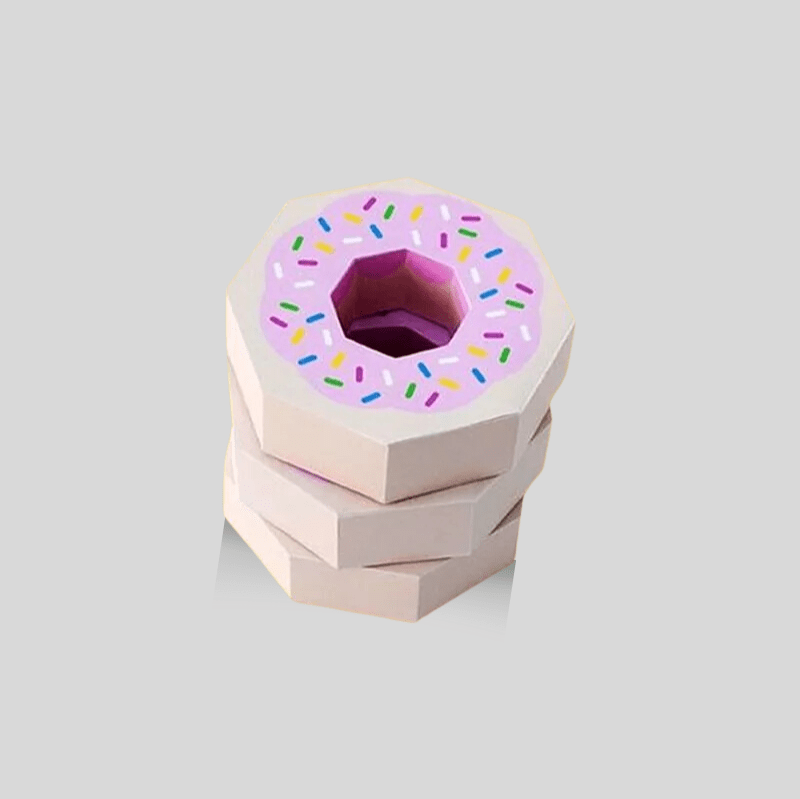
Prioritize information hierarchy before decorative effects. The lid can carry the primary brand mark and opening cue. Side panels can hold ordering details, storage or handling language approved by the bakery, flavor identification, contact information, or a QR code. Leave a clear area for variable order labels if staff apply them at pickup.
Prepare artwork on the approved dieline. Keep logos, small text, QR codes, and critical information away from folds, locks, glue zones, perforations, window cuts, and handle openings. Brisk's packaging artwork file preparation guide gives a prepress checklist.
Choose CMYK or Pantone references according to artwork, color expectations, substrate, process, and quantity. Ask for a material-specific proof because white SBS and brown kraft will not reproduce the same design identically. If multiple seasonal versions share one structure, supply clear file names and quantities for each version.
Aqueous coating, matte lamination, gloss lamination, and grease-resistant treatments can affect look, feel, rub behavior, folds, and disposal pathways. More finish is not always better. Confirm which surfaces need protection and whether each ink, coating, film, or adhesive is suitable for its location in the defined food-contact system.
8. Test the full bakery and delivery workflow
A box can pass a visual review and still slow service or damage food. Run a production-style trial with flat components, normal staff, real donuts, liners, labels, bags, racks, and delivery equipment.
Use a documented test:
Cool and finish donuts as they would be for sale.
Assemble the box and record time and common errors.
Add liners, cups, or dividers in the intended sequence.
Pack the most demanding assortment and record placement difficulty.
Close the box without contacting toppings.
Stack it as it would be stored and handed off.
Carry it by the normal support points or handle.
Run the expected delivery route or a repeatable handling simulation.
Open and serve from the pack as a customer would.
Record grease marks, product movement, topping transfer, crushed edges, window contact, base flex, opening, and print scuffing.
Repeat the test after changing one variable at a time. This makes it easier to identify whether a problem came from dimensions, board, layout, barrier, closure, stacking, or handling. Do not label a design “delivery-proof.” Performance varies with products, temperature, route, staff, and customer handling.
9. Understand quote and cost factors
Custom donut box pricing depends on the complete specification, including:
Internal length, width, and height;
Count, product layout, and number of box sizes;
Board type, grade, caliper, and color;
Liner, cup, insert, divider, or food-contact barrier;
Window size, shape, film, and patching;
Handle, lock, perforation, or other structure;
Print process, colors, coverage, and artwork versions;
Coating, lamination, or grease-resistant treatment;
Quantity by size and artwork;
Prototype, proof, and packed-product testing;
Flat or assembled supply, destination, and schedule.
Compare supplier proposals using the same specification. Confirm whether tooling, structural design, proofing, inserts, liners, freight, and packing cartons are included. Current website fields can change, so verify minimum quantity and production timing in the project quote rather than building an operational plan around a cached number.
For a project-specific recommendation, request a Brisk quote or contact a packaging specialist. Send actual donut measurements, assortment photos, count and layout, quantity by artwork, packing temperature, barrier needs, route, destination, and target schedule. Request a dieline, material-specific proof, physical sample, and packed-product trial before production approval.
Donut box quote checklist
Finished dimensions and photos for every product family;
Tallest topping, widest product, and expected batch variation;
Glaze, icing, sugar, crumb, nut, and grease characteristics;
Count formats and sales volume by format;
Mixed-assortment rules and proposed packing diagram;
Single layer, stacking, liner, cup, or divider requirements;
Preferred board or request for a material recommendation;
Window, handle, closure, and label-area needs;
Print files, brand colors, finishes, and artwork versions;
Food-contact boundaries and documentation questions;
Counter, catering, pickup, and delivery workflows;
Storage, stacking, bag, rack, and vehicle constraints;
Sample, proof, test, destination, and schedule requirements.
FAQ
What size should a donut box be?
Size the box from the maximum finished donut dimensions, count, layout, topping clearance, liners or cups, and working room for packing. There is no reliable universal size for every ring, filled, bar, mini, or specialty donut. Measure multiple production batches and verify a physical sample.
Do donut boxes need grease-resistant treatment?
That depends on the donut, packing temperature, hold time, board, liner, and expected contact. Test the oiliest representative product in the complete package. Ask the supplier to specify the board, coating or liner, and food-contact suitability for the intended use.
Should a donut box have a window?
A window can display the assortment and help verify orders, but it removes board from the lid and may collect powder, glaze marks, or condensation. Test product clearance, window cleanliness, lid stiffness, stacking, and handling before choosing it.
Can different donut types share one box?
They can when dimensions, surface sensitivity, grease, and clearance are compatible. Create an assortment matrix and packing diagram. Separate specifications may be better when tall decorated donuts, long bars, sticky glazed products, and small plain rings perform differently.
Are inserts necessary for donut boxes?
Not always. A well-planned single-layer grid may control movement without an insert. Cups, dividers, or trays can help separate delicate products, but they add components and labor. Test placement, removal, grease behavior, and movement before deciding.
What should I provide for a custom donut box quote?
Provide finished product dimensions, photos, count formats, layout, quantities by size and artwork, board preference, barrier and food-contact questions, window and finish needs, packing workflow, delivery route, destination, and schedule. Ask for dieline review, a material-specific proof, samples, and packed-product testing.
Final takeaway
The right custom donut box is a tested system, not merely a printed carton. Measure finished products, classify the assortment, choose counts from real orders, manage grease and topping transfer, and select board, windows, printing, and closures for the actual bakery route. A physical sample packed with the hardest realistic assortment provides better evidence than a nominal size chart. Brisk can review the specification, dieline, material, artwork, samples, and quote before production.