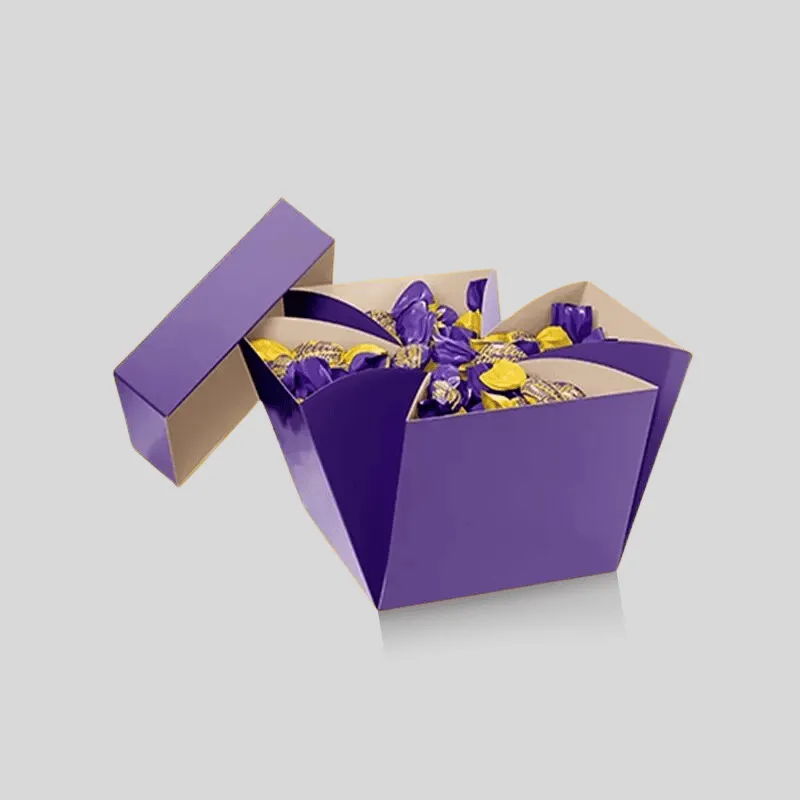
Choose custom popcorn boxes around the popcorn at the moment it is packed and served. Define whether it is hot and freshly popped, cooled and prepacked, heavily seasoned, gifted, or shipped. Measure a real serving by both weight and settled volume, then evaluate oil resistance, seams, filling speed, grip, access, stability, storage, and disposal. Test a physical sample during a realistic service rush before approving production.
Brisk's Custom Cardboard Popcorn Boxes page is the primary commercial destination for this packaging format, while the Custom Popcorn Boxes category shows related structures. This guide helps cinemas, concessions, event businesses, caterers, gourmet popcorn brands, and packaging buyers create a more useful specification and quote request.
1. Define the popcorn and the job of the package
Popcorn packaging is not one universal format. A wide open carton filled at a cinema counter has a different job from a sealed bag inside a printed retail box. A caramel popcorn gift set has different handling and barrier needs from hot buttered popcorn eaten immediately. Start by recording the product, process, channel, and expected time in the package.
Your product profile should include:
Popcorn style, kernel size, expansion variation, breakage, and loose fines;
Finished serving weight and settled volume, not only the weight of unpopped kernels;
Oil, butter-style topping, caramel, cheese powder, sugar, salt, and other seasoning exposure;
Product temperature and moisture condition when the container is filled;
Immediate consumption, short hold, takeaway, event favor, retail, gift, or e-commerce use;
Open-top access, lid, tuck closure, tamper feature, reclosure, handle, or dispenser needs;
Filling method, expected service rate, storage space, and staff training;
Label, allergen, nutrition, flavor, event, barcode, and date or lot information defined by the responsible food business;
Outer-case orientation, delivery route, and customer carry conditions.
Separate direct service from shelf-life packaging. An open carton can be effective for a serving intended to be eaten promptly, but it should not automatically be treated as a moisture or oxygen barrier for long retail storage. A sealed primary pouch may control the food environment while a paperboard carton or gift box provides protection, branding, stacking, and label area. Define which layer performs each function.
2. Size from a real popped serving
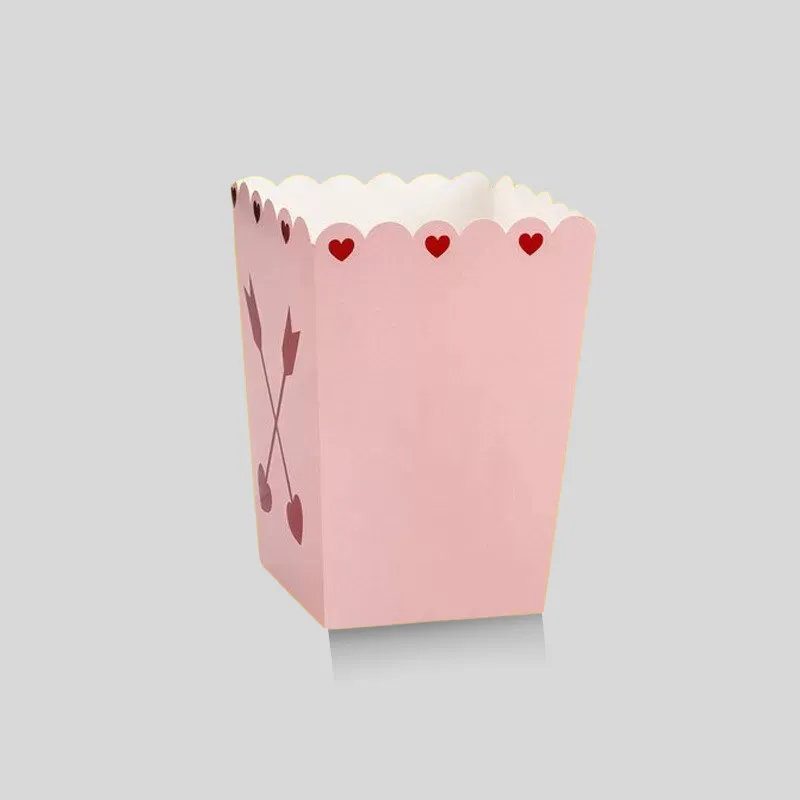
Popcorn has low bulk density and irregular geometry, so weight alone does not define a useful container. Prepare the actual recipe using representative kernels, oil, coating, and seasoning. Fill several portions with the same scoop and motions staff will use. Record both net weight and the volume or fill line after normal settling.
The package needs enough usable internal volume to receive the serving without constant spillover, but excessive headspace can make the portion look small and waste board, storage, and case volume. Do not compress popcorn merely to reach a fill line; compression can increase breakage and create an inconsistent customer experience. Establish an acceptable fill range and train the serving method around it.
Check the largest real-world condition rather than an ideal sample. Coated gourmet popcorn may occupy space differently from plain salted popcorn. Product can settle during carrying. A broad top opening may make scooping easier, while a narrow base can affect stability and the distribution of small broken pieces. If one brand offers several serving sizes, build a matrix showing finished dimensions, usable volume, target weight range, scoop, artwork version, case count, and counter storage requirement.
Brisk's guide on how to measure a box for custom packaging explains the conventional length, width, and height sequence. Confirm whether quoted dimensions are internal or external and whether taper, folded seams, a liner, lid, or reinforced base changes usable capacity.
3. Choose a structure for the sales channel
An open-top carton is familiar for cinemas, fairs, stadiums, and events because customers can reach the product and staff can fill through a wide mouth. Evaluate its top opening, taper, bottom construction, side seam, standing stability, and hand comfort. The best geometry balances fast access with reasonable spill control when the customer walks or places the pack in a cup holder or on a seat-side surface.
A closable folding carton can suit takeaway, catered events, favors, or products that need a more controlled handoff. Test whether the closure compresses the serving, traps steam, sheds crumbs when opened, or takes too long during service. A paper tub with a separate lid can support carrying and sharing, but the body, rim, and lid fit should be tested as one system.
For cooled, sealed retail popcorn, the primary barrier package may be a pouch, with an outer carton used for presentation or multipacks. Do not assume an open paperboard box can maintain the intended crispness or shelf period. Shelf-life design needs product-specific barrier evaluation and testing. For gift sets, a rigid or corrugated outer box can arrange sealed flavors and protect them during delivery.
E-commerce adds another layer. A decorative serving box should not be expected to survive parcel handling by itself. Use a suitable shipping container, orientation, dividers, and void control around sealed retail packs or gift components. Test the complete packed system rather than labeling one board grade “shipping safe.”
4. Specify materials, contact boundaries, and grease control
Popcorn may contact the board directly, so identify the exact material, coating, ink position, adhesive, seam, and conditions of use. Oil level, product temperature, contact duration, and seasoning all matter. Ask the packaging supplier for documentation relevant to the intended food and use, and confirm applicable requirements with qualified food-safety and regulatory advisers for each market.
The Brisk product API for Custom Cardboard Popcorn Boxes currently lists SBS paperboard, Bux board, kraft paper, and corrugated cardboard. It describes SBS and Bux board as food-safe options and lists kraft as food-safe, while the listed corrugated option is not marked food-safe. These records are useful starting points, not a substitute for verifying the exact material system selected for a project.
SBS offers a white print surface and is commonly considered for detailed branded folding cartons. Review caliper, stiffness, fold quality, coating, heat exposure, and grease performance in the final construction. Bux board is listed as a heavier white-board option; confirm its precise grade and converting behavior. Kraft creates a brown visual base that changes ink appearance, so approve color on the actual stock rather than on a white-screen proof.
Corrugated board can serve outer cases, mailers, and larger gift packs, especially where stacking and transit protection matter. If it is not suitable for direct food contact in the chosen specification, use an appropriate primary package or liner. Transit strength and food-contact suitability are separate questions.
Brisk's API also lists aqueous coating for this product. A coating should be selected and tested for a defined function—not assumed to make every board greaseproof, waterproof, heatproof, recyclable, or universally food-safe. Inspect the base, corners, score lines, cut edges, glue seam, and hand-contact areas after holding the real popcorn. Oil can expose weak points that a flat material swatch does not show.
5. Design for fast filling and comfortable eating
Packaging performance begins behind the counter. Observe staff receiving, storing, assembling, filling, staging, and handing off the box. A visually distinctive shape can become expensive in practice if it opens slowly, requires several pre-folds, springs closed, tips while empty, or occupies too much counter space.
Run a timed but safety-conscious service simulation. Place flat blanks or nested formed packs where they will actually be stored. Have representative staff open each pack, hold it under the scoop, fill to the target portion, remove stray pieces, and pass it to a customer. Record assembly errors, spills, inconsistent fill, hand strain, and congestion. The aim is not an unsupported speed promise; it is evidence about your own service line.
Customer handling deserves equal attention. Test small and large hands, one-handed carrying, sharing, reach depth, sharp corners, surface temperature, and grip after oil exposure. A tall box may display branding well but become awkward to reach into near the bottom. A broad box may be easy to share but difficult to carry with a drink. Handles, lids, or closure tabs can help in some routes but add converting and assembly decisions.
Confirm the filled center of gravity. Test the box on counters, trays, seats, and other surfaces used in the venue. If a tapered structure nests for storage, make sure units separate cleanly without damaging print or slowing service. If cartons arrive flat, verify that folds and locks are obvious under real lighting and rush conditions.
6. Plan artwork, flavor versions, and label zones
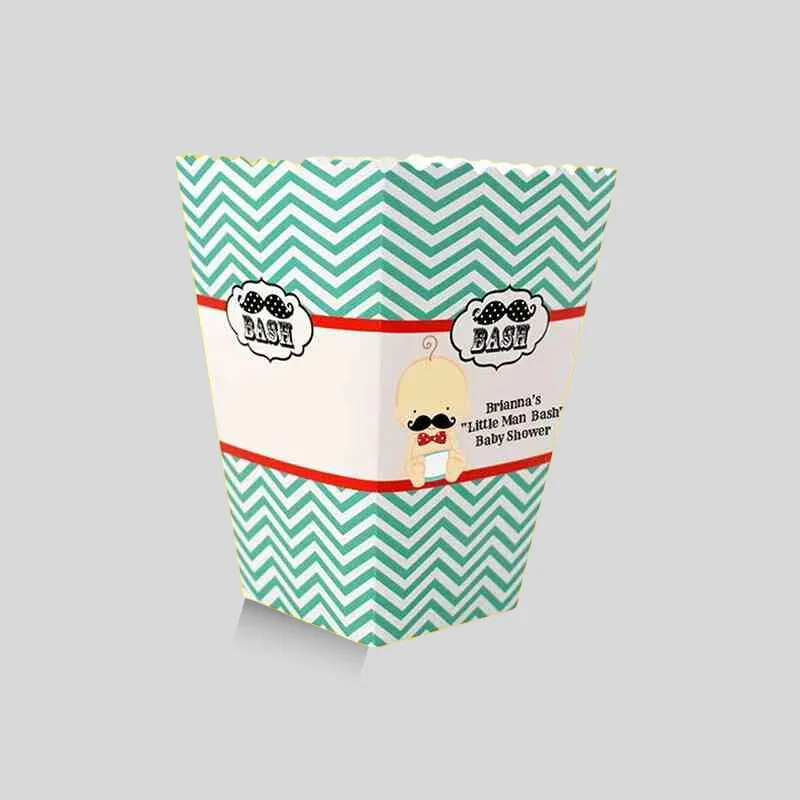
Create artwork on the approved production dieline after size and structure are tested. Keep logos, flavor names, small text, barcodes, QR codes, and required product information away from folds, scores, glue zones, tapered distortions, perforations, and hand-worn corners. Brisk's packaging artwork preparation guide provides a practical prepress checklist.
Decide which panel remains visible when the box is held. A strong front facing can identify the venue or brand, while side panels can distinguish portion or flavor. For event sponsorship, movie promotions, seasonal art, or multiple venues, create a release table connecting each SKU to its dimensions, dieline, artwork filename, barcode or approved copy, quantity, market, and approver.
Color should be approved on the selected stock and finish. Kraft, white paperboard, matte surfaces, and gloss surfaces can produce different results. Brisk lists CMYK and Pantone printing in the product record, plus matte and gloss lamination, die cutting, windows, handles, and perforation. Choose enhancements for a clear operational or visual purpose, then test their effect on folding, gluing, grip, heat, coding, and disposal.
A window is more relevant to sealed retail or gift formats than to a conventional open-top serving carton. It removes board from a panel and introduces film and adhesive. Confirm that it does not weaken the box, conflict with label space, or imply product protection it does not provide. Avoid broad environmental claims based only on paper color or a single component; evaluate and substantiate claims for the complete package in its target market.
7. Test service, holding, carrying, and distribution
A rendering can validate graphics, but it cannot reveal grease marks, weak seams, spills, awkward reach, or slow assembly. Order a production-representative sample and test it with the actual popcorn, scoop, staff, counter layout, labels, outer cases, and customer route.
Use a documented test sequence:
Condition the package and product as they will be stored before service.
Assemble or separate containers with representative staff.
Fill multiple servings at normal pace and record weights, fill levels, spills, and damaged pieces.
Hold the product for the expected service interval and inspect steam, softening, oil transfer, odor, print, coating, corners, base, and seam.
Carry the pack one-handed and with typical companion items such as a drink or event materials.
Place it on intended counters, trays, seats, tables, or carriers and check tipping.
Let users eat from the top to the bottom and note reach, crumbs, sharp edges, heat, grip, and access.
Pack containers into the master case and evaluate count, orientation, crushing, scuffing, storage, and replenishment.
For takeaway or shipped formats, simulate the representative delivery route with the complete primary and outer packaging system.
Record failures and revise one variable at a time before retesting.
Define pass/fail criteria before the trial. Examples include no seam opening, no bottom failure, acceptable exterior oil marking after a stated hold, fill weight within the brand's controlled range, stable standing on specified surfaces, readable artwork, and assembly steps staff can complete consistently. Criteria should match the actual project rather than generic claims.
8. Understand quote and cost factors
A useful quote compares the same complete specification across suppliers. Popcorn-box cost can change with:
Finished internal dimensions, taper, serving volume, and size count;
Open, closable, tub, sleeve, gift, or outer-shipping structure;
Board grade, caliper, surface, coating, liner, and direct-contact requirements;
Bottom lock, seam, lid, handle, window, perforation, or special die cut;
Print method, color system, coverage, inside printing, and artwork versions;
Lamination, varnish, foil, embossing, or other finishes;
Flat versus nested or preassembled delivery and associated storage volume;
Quantity by size, flavor, venue, promotion, and artwork;
Dielines, proofs, physical samples, testing, master cases, freight, and schedule.
Brisk's current product record shows different minimum-order values in separate fields, so confirm current MOQ, lead time, shipping, and commercial terms in the written project quote instead of relying on a cached value. Also clarify what the proposal includes for structural design, tools, plates, proofs, samples, cartons, and delivery.
For project-specific support, request a Brisk quote or contact a packaging specialist. Send the finished popcorn recipe, fill temperature, oil and seasoning details, portion weight and settled volume, photos, preferred structure, service workflow, contact requirements, artwork versions, quantity by size, destination, storage limits, and launch date. Ask for a material-specific sample, dieline review, and real service-line trial before production approval.
Popcorn box quote checklist
Popcorn type, expansion, seasoning, oil, coating, and temperature at filling;
Target serving weight, settled volume, acceptable fill range, and scoop;
Immediate service, hold time, takeaway, retail, gifting, or shipping route;
Open top, taper, base, closure, lid, handle, liner, or window requirements;
Internal dimensions and whether supplier measurements are internal or external;
Food-contact boundaries and documentation required for the intended use;
Board grade, caliper, coating, seam, and exterior oil-mark criteria;
Staff assembly, counter storage, nesting, replenishment, and handoff process;
Customer grip, reach, carry, stability, and spill-control expectations;
Approved label content, panel map, flavor or event versions, and barcodes;
Print colors, inside coverage, finish, proof, and sample requirements;
Quantity per size and artwork, case count, destination, and schedule.
FAQ
What material is best for custom popcorn boxes?
There is no universal best material. Select the exact stock and coating for the popcorn's oil, seasoning, temperature, contact duration, serving format, print needs, and route. Verify every direct-contact component and test the assembled box with the real product. Use a suitable primary package when the outer carton is not intended for direct contact or barrier performance.
How do I choose the right popcorn box size?
Prepare the actual popcorn and fill several servings with the production scoop. Measure both net weight and normally settled volume, then test the usable internal capacity of the proposed shape. Include taper, seams, bottom panels, fill variation, customer access, and an appropriate headspace without compressing the popcorn.
Do popcorn boxes need a grease-resistant coating?
That depends on the recipe, oil or topping level, temperature, hold time, board, and acceptable appearance. Test the exact coating and construction, including scores, seams, base, corners, and cut edges. A coating name alone does not prove performance for every popcorn or service condition.
Are open-top boxes suitable for retail popcorn?
They can work for immediate service, but a long-hold or shelf-life product generally needs a packaging system designed and tested for the required containment and barrier conditions. A sealed pouch may serve as the primary package while a carton provides branding and protection. Determine shelf life through qualified product-specific testing.
Should popcorn boxes ship flat or preassembled?
Flat cartons can reduce inbound storage volume but require reliable setup during service. Nested or preassembled formats can simplify filling but may occupy more space and can stick together. Compare storage, replenishment, assembly consistency, labor, case count, and service-line evidence for your operation.
What information should I send for a popcorn-box quote?
Send popcorn and seasoning details, fill temperature, portion weight and volume, intended hold and route, preferred structure, contact boundaries, dimensions, coating needs, artwork versions, quantities, destination, and schedule. Include photos of the product and current workflow, then request dieline review, a material-specific sample, and a realistic filling test.
Final takeaway
The right custom popcorn box connects product, portion, material, structure, staff workflow, and customer use. Measure a real popped serving, distinguish immediate service from sealed retail packaging, verify the direct-contact system, and test oil, heat, seams, grip, access, stability, storage, and carrying under realistic conditions. A physical service trial will reveal issues that artwork and generic specifications cannot. Brisk can review your structure, materials, coating, dimensions, dieline, sample, and project quote before production.