Choose custom sandwich packaging from the assembled product outward. Measure the bread footprint, cut orientation, finished stack height, filling movement, sauce and grease exposure, and required headspace. Then match a wedge, carton, wrap-and-sleeve, or clamshell to the sandwich's temperature, display, holding time, customer access, and delivery route. Verify every food-contact component and test representative packed products before approving production; a box that photographs well can still compress bread, trap moisture, leak filling, or slow service.
Brisk's Sandwich Packaging product page is the commercial destination for custom specifications. The Food Boxes category shows broader food-service formats. This guide gives cafes, delis, bakeries, convenience retailers, caterers, and delivery kitchens a practical specification and testing process.
1. Define the sandwich and its complete route
“Sandwich” covers very different products. A chilled triangular sandwich, thick deli stack, toasted panini, soft roll, baguette, bagel, wrap, and sauce-heavy breakfast sandwich do not create the same packaging requirements. Before requesting a dieline, document what enters the package and what happens next.
Record:
Bread type, shape, dimensions, softness, crust, and cut orientation;
Finished sandwich weight, maximum stack height, and natural variation;
Filling type, loose ingredients, sauces, oils, cheese, and potential migration;
Whether the product is chilled, ambient, freshly toasted, or packed warm;
Time and conditions between assembly, packing, display, pickup, and eating;
Refrigerated shelf display, front-counter service, catering, pickup, or delivery;
Whether the customer eats from the pack, removes the sandwich, or needs reclosure;
Required label, date, ingredient, allergen, nutrition, barcode, price, and traceability areas;
Expected orientation in a shelf tray, catering case, delivery bag, or customer's hand.
Separate product quality controls from packaging claims. Packaging is one part of a food-safety and quality system; it does not establish a shelf life on its own. The responsible food business should validate recipe, preparation, cooling or heating, storage temperature, labeling, hygiene, and use-by controls with qualified advisers for the relevant market.
2. Measure the finished sandwich, not only the bread
Bread dimensions are only the starting point. Fillings can increase height, overhang the edges, shift toward the cut face, or make one side thicker. Toothpicks, wraps, liners, labels, and presentation boards also consume space. Measure several products assembled at normal working pace by different staff, including the highest acceptable filling load.
For a triangular wedge, record the two short edges, diagonal cut face, depth, and maximum thickness at multiple points. For a rectangular carton, measure the complete footprint and height after the product has settled naturally. For rolls and baguettes, note length, diameter, tapered ends, and whether the package must prevent rolling. Brisk's box measurement guide explains the conventional length-width-height sequence; confirm whether quoted dimensions are internal or external.
Allow enough clearance for efficient loading and removal without allowing excessive movement. A tight box can compress soft bread, force fillings outward, smear a window, or make staff touch the product while closing the pack. Too much space can let the sandwich slide, separate, or look undersized. Use a tested fit range rather than designing around one showroom-perfect sample.
Create a size matrix when several menu items share packaging. Include sandwich SKU, bread, cut, finished dimensions, acceptable weight or height range, liner, carton code, artwork revision, label, case identification, and packing station. This makes consolidation decisions visible: one carton may serve several similar products, but forced standardization can create recurring waste or damage.
3. Compare structures by product and channel
Triangle wedge carton
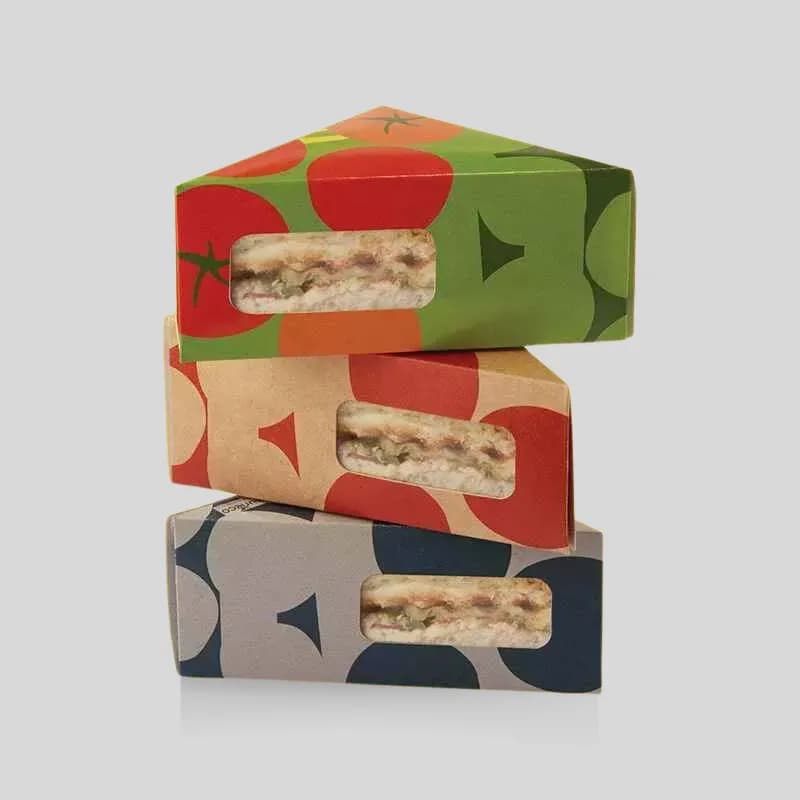
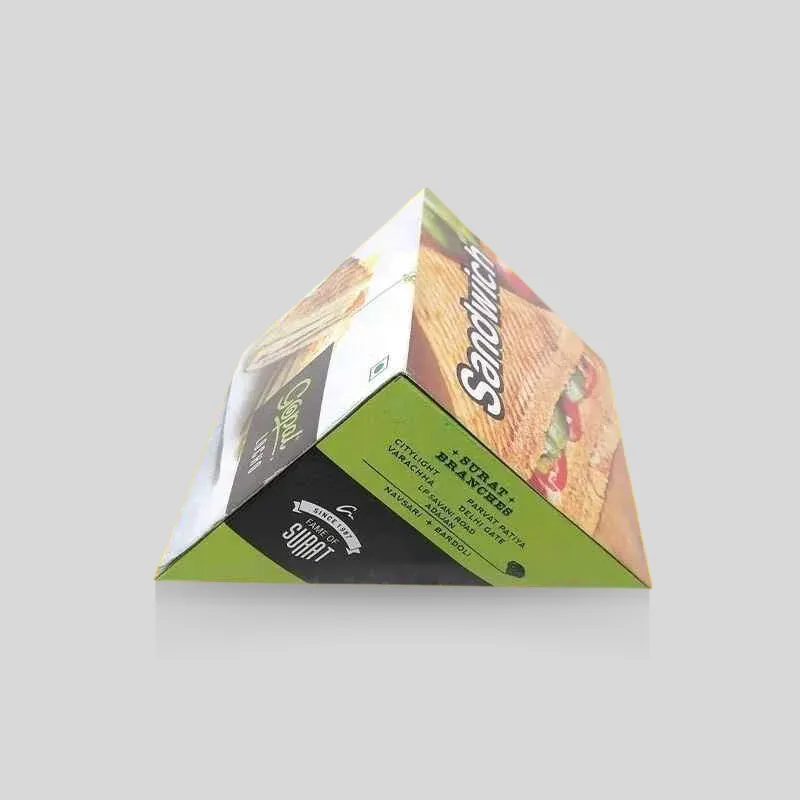
A wedge presents a diagonal cut face and can use shelf space efficiently for chilled grab-and-go sandwiches. Evaluate depth at the widest filling point, tip clearance, closure security, stacking direction, and how easily staff insert the sandwich without dragging fillings. If a clear window shows the cut face, test fogging, smearing, glare, film tension, and whether the visible product remains representative throughout display.
Rectangular folding carton
A rectangular carton can suit square sandwiches, rolls, bagels, breakfast products, or multi-piece portions. Options may include a tuck lid, locking corners, tear-open panel, or hinged top. Check whether the base remains level, whether end panels restrain movement, and whether the customer can remove a soft sandwich without turning the pack upside down.
Wrap plus paper sleeve
A food-contact wrap can contain crumbs, oil, or loose fillings while a printed sleeve provides branding and handling. This system may use less rigid board than a full carton, but two components add packing steps and version-control requirements. Test wrap folds, closure labels, sleeve grip, print rub, and whether the inner wrap obscures required information.
Clamshell or hinged pack
A hinged structure supports quick loading and broad access. It may suit immediate service or products requiring more crush protection. Check hinge memory, latch engagement, nesting, exterior heat, venting, and whether the lid springs into staff or customer hands. A format suitable for a cold sandwich is not automatically suitable for a hot toasted product.
Catering tray or multipack
Multiple sandwiches need separation, count control, and transport protection. Determine whether pieces are individually wrapped, divided by flavor or allergen protocol, and restrained from sliding. Test the complete tray, lid, liner, label, outer case, and carrying method rather than scaling up a single-pack assumption.
4. Manage moisture, grease, heat, and compression
A sandwich contains several interacting moisture sources: bread, vegetables, spreads, hot fillings, condensation, and the surrounding environment. Packaging cannot make incompatible ingredients stable indefinitely. Use recipe and process controls—such as ingredient preparation, drainage, cooling, layering, and assembly timing—alongside the package.
For chilled display, evaluate condensation after the product and package move through real preparation and refrigeration conditions. Moisture may soften paperboard, cloud a window, loosen a label, or collect near folds. For toasted or warm sandwiches, a tightly closed carton can retain steam, while excessive openness can lose heat and expose the product. Define the actual eating interval and compare vent and headspace options with controlled trials.
Grease and sauce can travel through cut edges, score lines, corners, and glued seams even when a flat board swatch appears resistant. Inspect every contact point after the intended holding period. Include high-sauce and high-oil variants, not only the driest recipe. If a liner or wrap is needed, test whether it stays in place and whether staff can apply it consistently.
Compression must be evaluated through the complete route. Cartons may be stacked in a refrigerated display, pressed inside a catering case, or placed beneath heavier items in a delivery bag. Check bread deformation, filling displacement, closure opening, window contact, and carton bowing after representative stacking and vibration. Do not use a decorative primary carton as a parcel shipper unless the full distribution system has been engineered and tested for that purpose.
5. Verify materials and food-contact boundaries
The Brisk API currently lists SBS paperboard, Bux board, kraft paper, and corrugated cardboard for Sandwich Packaging. It also lists aqueous coating and window patching among available add-ons. These are option records, not proof that every combination is appropriate for every recipe, temperature, contact duration, market, or recovery stream.
SBS provides a white printable surface and can suit detailed branded cartons. Evaluate caliper, stiffness, score quality, fold memory, surface treatment, and barrier performance in the converted package. Bux board is listed as a heavier white-board option; confirm the exact supplied grade. Kraft gives a brown base that changes printed color and contrast. Do not call the complete pack recyclable, biodegradable, compostable, or otherwise environmentally preferable without evidence covering the board, coatings, film, adhesive, ink, labels, contamination, and local collection route.
Corrugated material may be appropriate for outer cases, catering carriers, or larger distribution packs. The current Brisk product record does not mark its listed corrugated option as food-safe. If it is used outside the primary contact layer, define that boundary clearly and verify the inner food-contact component.
Ask for project-specific documentation for the precise board, coating, window film, ink, adhesive, label, and liner. Confirm intended temperature, greasy or aqueous food exposure, duration, and direct versus indirect contact. Keep print and adhesive out of direct-contact zones unless the complete system has been specified for that use. Regulatory suitability should be reviewed by the responsible business and qualified specialists; a material name alone is not approval.
6. Engineer windows, labels, and tamper evidence
A window can help shoppers inspect the cut face, but it removes printable board area and adds a film, adhesive interface, and potential recovery complication. Position it around the product's normal location, not a manually arranged photo. Keep enough board around the cutout for stiffness and sealing. Test film scratching, fogging, product smears, delamination, glare under store lighting, and deformation during stacking.
Place labels only after studying the assembled carton. A label crossing a fold may lift; one placed on a cold or damp surface may need a different adhesive; one across a window may hide the product. Reserve clear zones for mandatory information, barcode scanning, price labels, date coding, and store-specific stickers. Confirm who prints and applies each label, at what temperature, and how errors are corrected.
If tamper evidence is required, define what the customer should see and how staff apply it. A seal should not cover key information, tear the carton unpredictably, or create a difficult opening. Test intentional opening, accidental handling, condensation, refrigeration, delivery friction, and residue. Avoid describing ordinary tuck flaps as tamper-evident without a validated feature and procedure.
Artwork should follow the approved structural dieline. Keep logos, small text, barcodes, QR codes, and critical copy away from cuts, scores, glue zones, windows, locks, and curved panels. Use Brisk's artwork preparation checklist, then approve color and readability on the selected stock and finish rather than relying only on a monitor rendering.
7. Design for packing speed, display, and customer use
Observe the real workstation. Flat cartons must be stored, picked, formed, filled, closed, labeled, and staged. Nested or preassembled formats may use more storage space. Record assembly time, double picks, incomplete locks, torn tabs, label errors, dropped products, and touches near food-contact areas during a realistic rush.
For refrigerated retail, load a shelf tray as staff actually would. Check facing width, carton stability, label visibility, first-expiry rotation, removal, restocking, and whether the window still presents the sandwich after handling. Confirm that case counts and carton orientation work with refrigerator dimensions and replenishment routines.
Customer testing should include carrying with a drink or bag, opening while seated or walking, removing the sandwich without spilling fillings, eating from the package if intended, reclosure, and disposal. Watch for sharp corners, confusing opening points, loose windows, sauce transfer, and inaccessible final bites. Accessibility is a functional requirement, not an artwork detail.
For delivery, place the sandwich package with the complete order. Test bag orientation, seals, drinks, hot and cold neighboring items, vibration, stacking, driver handling, and the realistic route. Separating hot and chilled items may be an operational requirement beyond the carton itself.
8. Run a production-representative sample test
A digital mockup cannot reveal compression, condensation, sauce migration, window fogging, label lift, or slow assembly. Request structural and print samples appropriate to the stage, then test production-representative units before bulk approval.
Use a documented protocol:
Assemble several sandwiches across the approved ingredient and height range.
Pack them at normal line speed using the intended wrap, liner, label, and seal.
Record loading difficulty, closure failures, product contact, and pack time.
Place chilled, ambient, or warm products into their actual holding environment.
Inspect board, edges, seams, window, adhesive, label, and print at defined intervals.
Run shelf, catering, pickup, and delivery configurations with companion items.
Evaluate product movement, bread compression, filling escape, condensation, grease, access, and appearance.
Test case packing, storage, replenishment, stack load, and unit separation.
Define pass/fail criteria before testing, change one variable at a time, and repeat.
Shelf-life or food-safety validation needs an appropriate formal plan; sensory observations from an informal box trial are not a substitute. Retain approved specifications, dieline revision, sample, artwork, material declarations, and test records so future orders can be compared.
9. Cost factors and quote checklist
Comparable quotes must describe the same system. Price and production choices can change with finished dimensions, board grade and caliper, structure, window size and film, coating or liner, print coverage, number of colors, interior printing, labels, special cuts, glue operations, delivery format, quantities by SKU, tooling, proofs, samples, cases, freight, and schedule.
The live Brisk product record currently shows conflicting minimum quantities in different fields. Confirm current MOQ, timing, shipping, and included services in a written project quote rather than relying on cached page values. Ask whether dielines, design support, tooling, plates, proofs, food-contact documentation, labels, samples, and delivery are included.
Send this specification when requesting pricing:
Sandwich types, bread, cut, recipe, fillings, sauces, and temperature;
Finished footprint, height and weight ranges, plus photos;
Chilled display, immediate service, catering, pickup, or delivery route;
Expected holding conditions and time, controlled by the responsible food business;
Wedge, carton, clamshell, sleeve, wrap, liner, tray, or outer case;
Internal dimensions, headspace, vents, locks, windows, and access;
Food-contact boundaries and project-specific documentation needs;
Board, caliper, coating, film, adhesive, ink, labels, and tamper feature;
Artwork variants, mandatory information, barcode, date, and price zones;
Packing workflow, shelf configuration, case count, and storage limits;
Quantity per size and design, destinations, launch date, proof, and sample needs.
For support, request a Brisk quote or contact a packaging specialist. Ask for sandwich-package samples, material and window guidance, a dieline review, and a production-representative packed-product trial.
FAQ
What is the best material for custom sandwich packaging?
There is no universal best material. Select the exact board, coating, wrap, liner, window film, ink, adhesive, and label for the recipe, temperature, contact duration, display, print, and route. Verify documentation and test the converted package with representative sandwiches.
How much space should a sandwich box allow?
Allow enough clearance to load and remove the highest approved sandwich without compressing bread or pushing out fillings, but not so much that the product slides or appears undersized. Measure several normal production samples and validate an acceptable fit range.
Should sandwich packaging have a clear window?
A window can improve product visibility, especially for grab-and-go display, but it adds film and adhesive interfaces and may fog, smear, scratch, or reduce carton stiffness. Test it with the actual sandwich, refrigeration, lighting, stacking, labels, and disposal system.
Is a triangle wedge always best for sandwiches?
No. A wedge is useful for many diagonally cut chilled sandwiches. Rectangular cartons, wraps with sleeves, clamshells, or catering trays may fit rolls, panini, bagels, uncut sandwiches, hot products, or multipacks better. Choose by product geometry and route.
How should hot sandwich packaging differ from cold packaging?
Hot products may release steam and require controlled venting, headspace, heat handling, and shorter service-route testing. Chilled products may emphasize condensation, refrigeration, label adhesion, shelf presentation, and cold-chain controls. Test each condition separately rather than using one unverified specification.
What should I send for a sandwich-packaging quote?
Send product dimensions and photos, temperature and route, structure preference, contact requirements, board and window needs, labels and mandatory copy, artwork variants, quantities, destination, schedule, and sample requirements. Include the tallest and messiest approved sandwich variants for fit and barrier testing.
Final takeaway
Effective custom sandwich packaging aligns product geometry, filling behavior, temperature, moisture, materials, windows, labels, staff workflow, shelf presentation, and customer handling. Measure real assembled sandwiches, preserve transactional ownership on the product page, verify every food-contact component, and test the complete packed route. Brisk can help review your structure, dimensions, materials, window, dieline, sample, and project-specific quote before production approval.