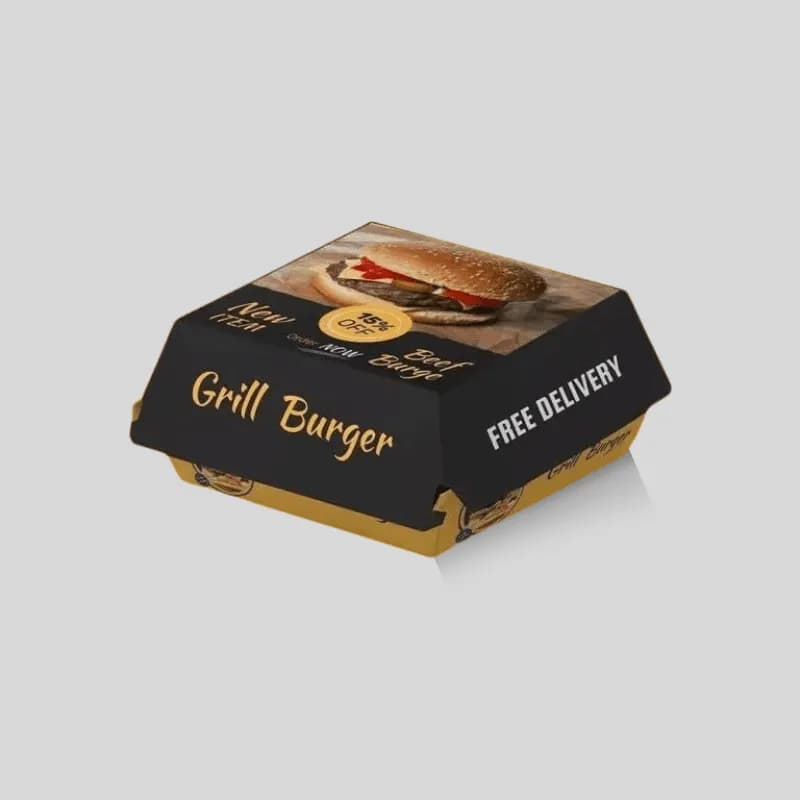
Choose custom burger boxes around the complete assembled burger, its temperature and moisture at packing, the required food-contact system, service speed, hold time, and delivery route. Measure representative builds with the bun, fillings, sauces, wraps, liners, and picks in place. Then prototype the internal fit and test grease resistance, steam release, closure, stacking, bag loading, and arrival condition using real orders before approving production.
Brisk's Custom Burger Boxes page is the canonical commercial owner for burger packaging. This guide supports that product page with a practical selection and quote workflow rather than competing for the transactional head term.
Start with burger builds and service routes
One box rarely fits every menu item well. A single smash burger, a tall double burger, a brioche bun with delicate toppings, and a sauced plant-based sandwich can differ in footprint, height, grease, moisture, and stability. The same burger also faces different hazards at the counter, in a pickup rack, or during a motorcycle or car delivery.
Create a packaging brief for each meaningful build:
Finished burger diameter or length, total height, weight, bun softness, filling movement, and expected variation;
Hot components, cold garnishes, sauces, cheese, oils, and any item likely to leak or transfer moisture;
Wrap, liner, food pick, label, tamper-evident seal, napkin, condiment, or side packed with it;
Dine-in, counter takeaway, curbside pickup, catering, drive-through, or third-party delivery route;
Typical and worst-case time between packing and eating, based on the restaurant's real operation;
Bag orientation, stacking pattern, number of boxes per order, and whether hot and cold items share a bag;
Kitchen assembly sequence, hourly peaks, storage space, artwork versions, destinations, and launch timing.
Do not promise that a paper box alone will keep a burger “fresh” or at a particular temperature. Product recipe, initial temperature, steam, ventilation, hold time, bag configuration, ambient conditions, and route all interact. Establish food-safety and time-temperature procedures independently with qualified specialists for the menu and market.
This burger-specific process complements Brisk's broader custom food packaging guide, but focuses on hot assembled food, bun compression, sauce and grease, condensation, fast packing, and delivery-bag handling.
Size the box around a production-representative burger
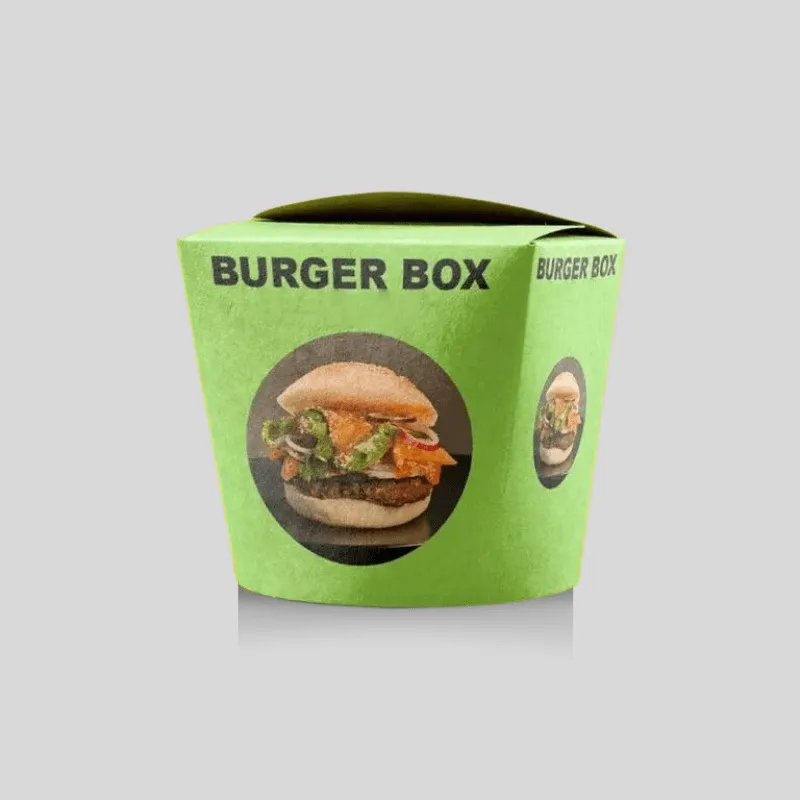
Measure the finished burger, not an unfilled bun or a menu specification. Use products made during normal service and include expected variation in bun diameter, patty placement, toppings, and sauce. Record maximum width, depth, and height after assembly. Brisk's box measurement guide explains the general distinction between internal and external dimensions.
Build the packed sample with every component. A liner fold, corrugated flute, locking tab, rolled edge, or closure feature consumes internal space. Leave enough clearance for staff to load the burger without scraping toppings and for customers to remove it without dismantling the stack. At the same time, excessive clearance allows sliding, tilting, and filling displacement.
Lid height is especially important. A shallow lid can compress the bun, smear sauce and cheese onto the top panel, or force the closure open. Too much headspace may let a tall burger topple during delivery. Test the shortest and tallest normal builds and inspect them after closing, stacking, carrying, and reopening.
Use a prototype to check hand movements during a real rush. Staff should be able to open, load, close, identify, and bag the pack consistently without touching interior food-contact areas unnecessarily. A design that looks refined in a rendering but slows every order is not operationally ready.
Compare structures by use case
Hinged clamshell-style cartons can support fast loading because the lid and base stay together. Review hinge fatigue, corner locks, lid clearance, opening control, and whether the closure remains secure after exposure to heat, grease, and handling. Make sure the opened lid does not interfere with loading on the actual preparation surface.
Folding cartons with tuck or lock closures store flat and provide large printable panels. They can be useful where storage efficiency and branding matter, but assembly steps, tab orientation, closure reliability, and loaded stack strength require testing. Compare manual setup time at both quiet and peak service.
Tray-and-sleeve concepts can create a deliberate presentation and expose the burger as the sleeve slides away. They add parts and hand movements, so evaluate whether the experience justifies the packing time and inventory complexity.
Corrugated constructions add fluted structure for heavier meals, grouped items, or demanding delivery routes. The burger may still need an approved liner or inner wrap. Do not assume that every corrugated option is intended for direct food contact simply because it appears under food packaging.
The right structure is the one that protects the actual burger through its actual route while remaining practical for staff and customers. Compare packed performance, assembly labor, storage cube, case packing, and delivery failures—not only the empty-box unit price.
Verify the complete food-contact system
The verified Brisk Custom Burger Boxes API record lists SBS paperboard, Bux board, kraft paper, and corrugated cardboard as available material directions. Its material-level food-contact flags differ. That is a useful warning against selecting by a generic name alone.
SBS can provide a smooth white surface for detailed printing. Kraft creates a natural brown appearance, but appearance does not prove recycled content, certification, compostability, or suitability for a specific hot, greasy food. Heavier white board may offer a different stiffness and presentation. Corrugated board provides fluted structure, but its liner, medium, adhesive, ink, and intended contact arrangement must all be reviewed.
Ask for written, project-specific information covering the exact stock, coating, grease treatment, ink, adhesive, liner, and seal. State the food type, direct or indirect contact, temperature conditions, contact duration, and destination market. Confirm which side is intended to contact food and whether folds or cut edges expose untreated material.
A liner or partial wrap can separate the burger from the carton, improve cleanup, and help manage grease, but it becomes another specified component. Test liner size, fold, migration, bunching, branding, and disposal instructions with the complete pack. Regulatory and labeling requirements vary, so have qualified food-packaging advisers review the final construction and claims.
Balance grease control, sauce containment, and steam release
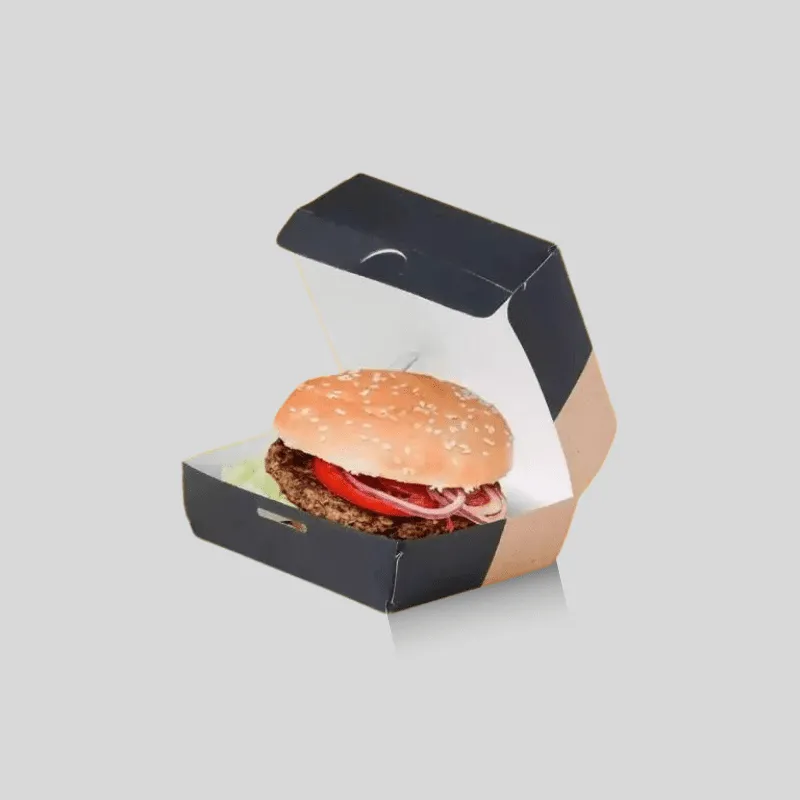
Hot burgers create a difficult combination: oils and sauces can soak or leak, while trapped steam can condense on the lid and soften the bun. A stronger moisture or grease barrier does not automatically solve condensation. Venting can release vapor, but its effect depends on hole size and position, burger temperature, route, bag airflow, weather, and hold time.
Treat grease resistance and ventilation as testable specifications. In packed trials, inspect the base, corners, folds, lid, exterior print, labels, and delivery bag. Look for darkening, wicking, softening, leakage, sauce escape, adhesive failure, warped panels, condensation droplets, and bun texture. Include the greasiest normal build and the longest intended service route.
Place vents only after studying how the box sits in a bag and stack. A blocked vent cannot work as intended; a poorly located opening can allow sauce leakage, debris entry, or unwanted heat loss. Do not copy a competitor's vent pattern without testing your burger and route. Compare no-vent and vented prototypes under controlled, documented conditions.
If the burger includes very wet toppings or loose sauce, packaging cannot correct an unstable recipe or assembly. Consider sauce quantity, ingredient drainage, wrap technique, layering, and separation alongside the box. The goal is a complete operating system; one coating or hole pattern cannot ensure quality in every use case.
Plan sides, seals, and delivery-bag stacking
Fries, sauces, pickles, and cold items should not be added to the burger cavity without evaluating movement, grease, aroma, temperature, and food-safety procedures. A partition, separate carton, cup, or bag position may be more appropriate. Test whether side containers press on the burger box or prevent vents from functioning.
Tamper-evident labels or seals may support a delivery process, but they must match the surface and closure. Evaluate adhesion on the selected coating at packing temperature, opening evidence, application speed, and whether the label blocks required artwork or vents. Do not describe a simple label as a complete safety system.
Build realistic delivery bags with the normal order mix. Stack the maximum intended number of loaded boxes, include drinks and sides in their proper carriers, carry the bag, place it on a vehicle seat or rack, and inspect the order at the expected destination time. Watch for panel collapse, popped locks, tilted burgers, blocked vents, grease transfer, and unreadable order labels.
Design print and information zones on the final dieline
A burger box can carry the brand beyond the storefront, but operational information comes first. Reserve zones for the logo, product or variant identification, order label, preparation marks, handling guidance, disposal instructions supported by evidence, and any information required for the intended use and market.
Use Brisk's artwork file preparation guide on the final production dieline. Keep critical text, QR codes, and graphics away from cuts, folds, glue areas, tabs, vents, grease-prone zones, and label locations. Scan every code from folded packed samples rather than a flat proof.
CMYK can reproduce multi-color artwork and photography, while selected spot colors may help control important brand colors. Review Brisk's CMYK versus Pantone guide, then approve physical color on the intended white or kraft stock and coating. Heat, grease, abrasion, stacking, and handling can affect appearance, so include rub and packed-use checks.
Finishes should serve a defined need. Lamination, aqueous coating, or decorative effects influence folds, glue, grease behavior, cost, and end-of-life claims. Confirm food-contact suitability for every relevant surface and avoid broad environmental language unless it is documented for the assembled package in the target waste stream.
Run packed kitchen and delivery tests
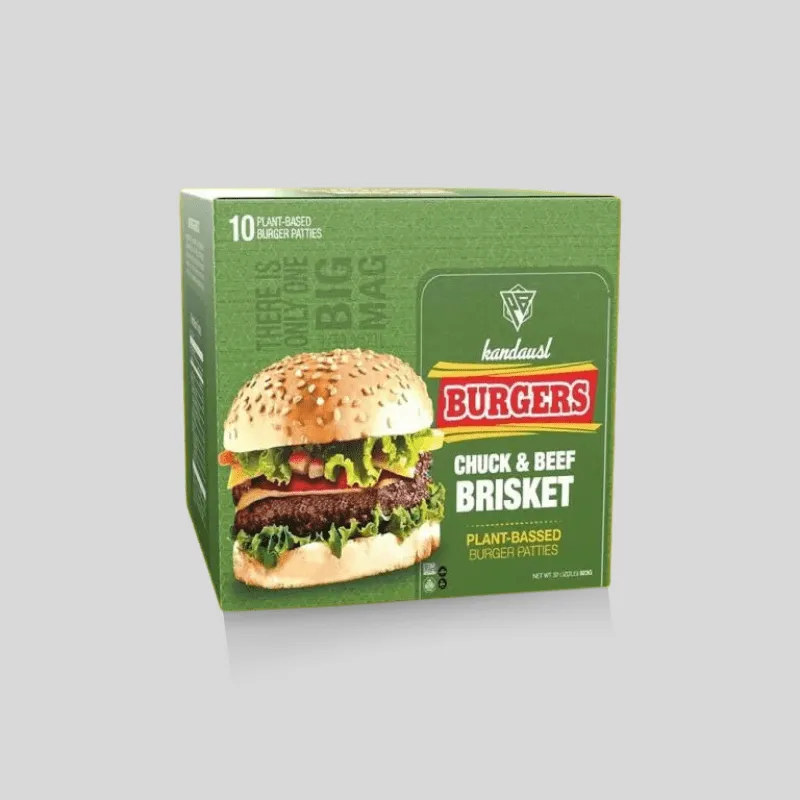
A digital proof verifies layout; it does not prove fit or service performance. Use a documented packed trial:
Select representative burger builds, including the tallest and greasiest approved variants.
Assemble them through the normal kitchen process with liners, wraps, picks, labels, and seals.
Time box setup, loading, closure, identification, and bagging during realistic service conditions.
Hold orders for planned intervals and routes without changing normal operating controls.
Stack and carry complete bags with representative sides and drinks.
Simulate actual handling, orientation changes, vibration, and reasonable delivery conditions.
Open and inspect bun compression, filling movement, grease, sauce, condensation, panel strength, closure, print, labels, and presentation.
Record the box construction, burger build, conditions, acceptance criteria, failures, revisions, and approver.
Repeat testing after changing dimensions, board, coating, liner, vent pattern, closure, or bag configuration. Establish project-specific acceptance criteria instead of relying on statements such as “leakproof” or “keeps food hot” without defined methods and evidence.
What affects burger-box cost and MOQ?
Cost is shaped by internal dimensions, structure, board grade and caliper, blank yield, quantity, print process, ink coverage, interior print, food-contact or grease-resistant treatment, liner, vent holes, gluing, assembly, labels, artwork versions, tooling, proofs, samples, case packing, freight, destination, and schedule. MOQ and turnaround depend on the frozen specification and production route.
Ask for quantity tiers against the same construction. Confirm whether the quote includes structural design, dieline, artwork support, physical sample, proof, tooling, coatings, liners, food-contact documentation, packing, freight, duties, and revisions. Brisk's live product page may show general terms, but request written terms for this exact burger-box project rather than assuming a site-wide number applies unchanged.
Standardizing one footprint across several burgers can simplify inventory only when fit and packed performance remain acceptable. If builds differ substantially, an insert, wrap, or separate size may reduce movement and compression. Compare packaging savings against kitchen errors, service time, storage, and delivery quality.
Quote checklist for custom burger boxes
[ ] Representative burger builds, packed dimensions, weights, heights, and variation
[ ] Ingredients affecting grease, sauce, steam, movement, or direct contact
[ ] Dine-in, takeaway, pickup, catering, or delivery routes and expected hold windows
[ ] Internal dimensions, structure, board grade, caliper, closure, vents, liner, and wrap
[ ] Exact food-contact conditions and required stock, coating, ink, and adhesive documentation
[ ] Kitchen assembly, peak packing speed, storage limits, stack, case, and bag configuration
[ ] Side items, condiment cups, labels, seals, order identification, and variant handling
[ ] Dieline, artwork versions, colors, QR codes, coding, coatings, and finishes
[ ] Packed grease, steam, closure, stacking, carry, and delivery tests with acceptance criteria
[ ] Quantities, destinations, samples, proofs, approvals, and launch date
FAQ: Custom burger boxes
What material is best for burger boxes?
There is no universal best material. Select the exact board, caliper, coating, liner, ink, and adhesive for the burger, contact conditions, route, structure, and print needs. Obtain project-specific food-contact evidence and test the complete packed construction.
How do I size a custom burger box?
Measure production-representative burgers after complete assembly. Include the widest footprint, tallest normal build, liners, wraps, and expected variation. Prototype internal dimensions that prevent bun compression while limiting sliding and tipping.
Should burger boxes have vent holes?
Vents may help release steam, but performance depends on their size and location, the burger, packing temperature, hold time, bag airflow, stacking, and route. Compare vented and unvented packed prototypes; do not assume one pattern works for every menu.
How can a burger box resist grease?
Specify and verify a suitable board, treatment, coating, liner, or wrap for the intended food and contact conditions. Test the greasiest approved burger through the longest route, inspecting folds, corners, cut edges, closure, exterior, and bag for wicking or leakage.
Can one box size fit every burger?
Sometimes, but only if the shortest, widest, and tallest builds all pass loading, closure, movement, stacking, and delivery tests. Large differences may justify separate sizes or a tested insert or wrap system.
What should I send for a burger-box quote?
Send representative burgers or accurate packed dimensions, build range, route, hold conditions, food-contact requirements, material and structure direction, liner and vent needs, artwork versions, packing workflow, test criteria, quantities, destinations, and launch date.
Request samples, dieline review, and a quote
Bring Brisk representative burger dimensions and builds, normal liners and labels, service and delivery routes, kitchen workflow, bag configuration, quantities, and test expectations. A packaging specialist can help compare board and structural directions while the Custom Burger Boxes page remains the commercial product owner.
Explore Brisk's Custom Burger Boxes and Food Boxes, then request samples, packed-food and dieline review, and a project-specific quote. Approve production only after fit, food-contact documentation, grease, venting, packing speed, print, closure, and delivery performance meet documented criteria.